
Interview with Lara Czernecki on Your Choice To Leave
Interview with Lara Czernecki on Your Choice To Leave
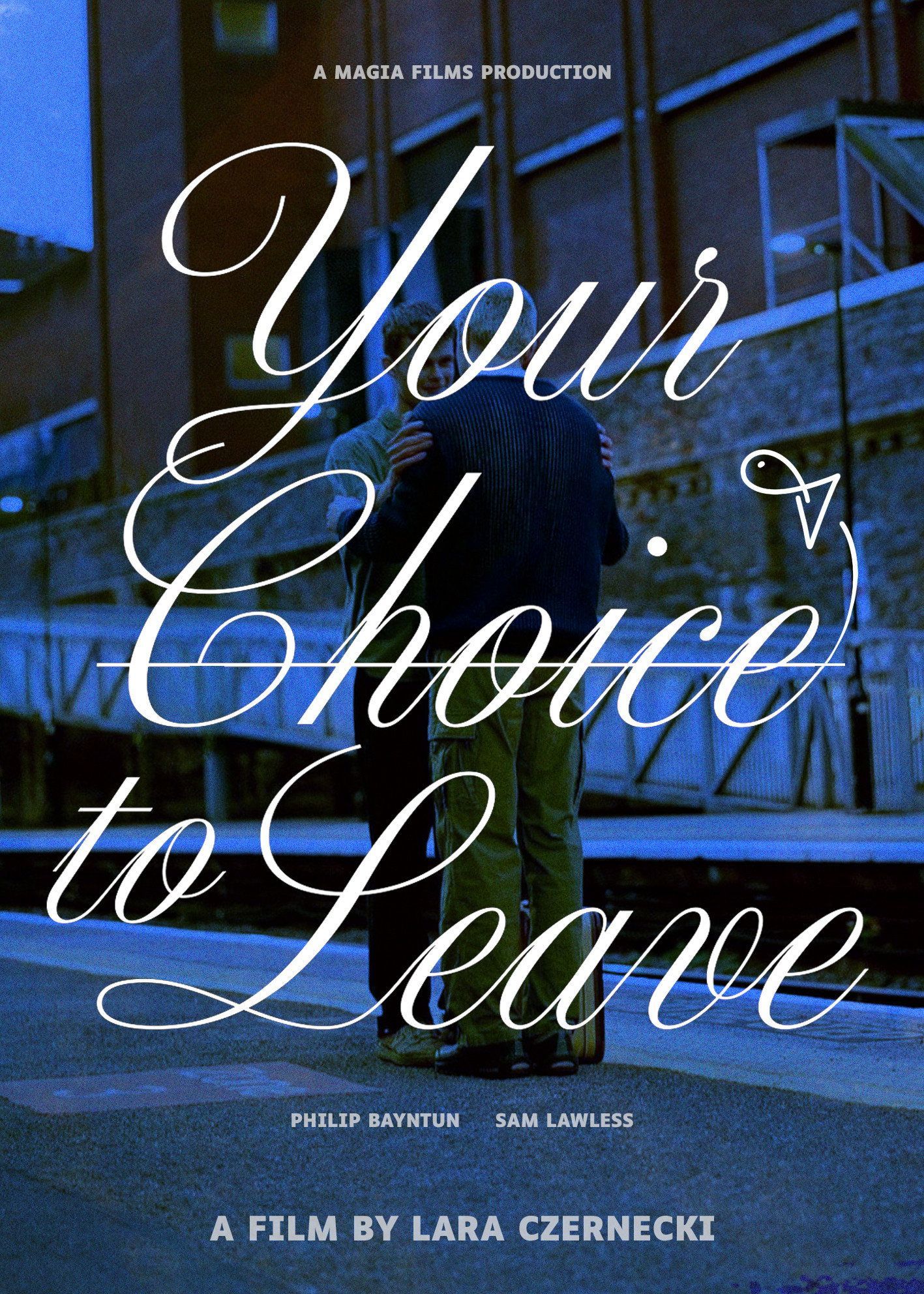
The first time I met Lara Czernecki, I thought that her wild enthusiasm — for daydreaming, for literature, for film, for life — had a slightly manic energy. This is probably because the Hungarian writer-director speaks twice as fast as the average person. What I realised later on is that she also thinks twice as fast, works twice as hard, and has twice as much creative brilliance; qualities that have contributed to a rapidly growing repertoire in film and theatre, a masters in the University of Cambridge, and the creation of her international production studio, Magia Films. Cinematically lush and deeply incisive in its authorial voice, her latest short film, Your Choice To Leave, manages to do something rare — it creates a world that gives you the space to remember, and to grieve.
Set over one sleepless night at a British boarding school,
Your Choice to Leave (YCTL) follows Daniel’s final hours with his best friend, Max, before the former is deported to Russia. As the two boys linger by empty corridors and fluorescent swimming pools, they must confront their fracturing world, and the fact that neither of them is ready to say goodbye.
YCTL has since won Best Short Script at the 2025 LEEDSflix film festival.
In the following interview, I had the privilege of speaking to Lara about creating this portrait of displacement, boyhood, and heartbreak.
Elena Goh (EG):
You mentioned that YCTL started with a sense of urgency, a feeling of isolation, and ended as a collective healing experience. Could you talk a bit about what inspired you to make the film?
Lara Czernecki (LC):
Hungary is in a very peculiar place at the moment. About a year ago, they changed the constitution regarding citizenship such that if you’re a dual citizen and a “danger to Hungarian sovereignty”, they can take away your Hungarian citizenship. Just reading that made me feel so scared and isolated, because there was this feeling of being suddenly erased from the place that I grew up in. I wrote YCTL within two days of that constitution change. A month after that, the UK government came up with a White Paper which outlined some very harsh immigration rules, and my Eastern European friends started having these very anxious phone calls about what to do next. So this idea of fragility as an immigrant is very much something that has been on my mind, this place where you ask, “Where do I go? Why doesn’t anyone want me?” YCTL tried to encapsulate this feeling of not being wanted by a country you call your own.
Because the film was for a UK audience, I wanted them to understand that it can happen to someone who has grown up here, who has the perfect British accent, who went to boarding school in the UK. In the film, Daniel’s home is the UK, where his friends and school and culture are, but just one line in the law changes that. In his situation, we wanted to touch upon what it’s like if you’re not in a financial situation where you can pay for all the legal services you need to stay in the country.
It’s really difficult to produce an indie project with limited resources, but the urgency of this global immigration debate pushed us to finish it. The people involved thought this film was important and relatable, and their passion was an incredible part of making it come alive.
EG:
In creating this film, did you take inspiration from other works of media?
LC:
Of course. YCTL is quite lyrical, and some of the main inspirations were works by Luca Guadagnino. Call Me By Your Name (2017) was a great inspiration for the film’s train scene. But regarding the thematic and stylistic world of this boarding school, Holdovers (2023) was very much an inspiration. The colour palette and the stillness of its shots were things we really reached for when making the film. Last year, we went to a screening of the Academy Awards nominated short films, and there was this short film called A Lien (2022), which is about US immigration and border control. That was another thing that awakened this urgency.
In the set design, I tried to be very intentional with the books each character owns. [Daniel is seen reading] ‘Metamorphosis’, ‘Lord of the Flies’, and ‘Animal Farm’, very political books that reflect our current reality. Max has comic books — which shows this very privileged, safe environment where he can grasp onto his childhood, while Daniel needs to be more politically literate. That’s something we really reached towards in set design, depicting that difference in their maturity and development in this coming-of-age movie.
EG:
About the reference to ‘Metamorphosis’, there’s a part where Daniel says, “I wish I could wake up as Gregor Samsa, because I want to be a bug with no immigration papers”. It struck me as poignant, because ‘Metamorphosis’ is very political, especially with the idea that Gregor is no longer socially legitimate because he can’t work. Was this parallel intentional?
LC:
Yes, a little. There was a line that ended up not making itself into the film, during the conversation in the pool scene. Daniel tells Max, “You’re like a fish, you go wherever you want and you’re free. I’m like a rock. Someone chucks me in a lake, and I’m just there.” There is something for Daniel about stasis, about staying where he is and hiding away from the world. They’re both turning eighteen in the film, and that’s when you’re not a child anymore. Suddenly, you have all these adult laws affecting you, and you have to face the consequences of everything set before you in the system. For Daniel, to be a bug in the place that you know is better than being yourself in a place that you’ve never considered your home.
EG:
In the film, I was struck by the way you approached immigration as an existential issue. Deportation isn’t just bureaucratic, it's an emotional experience of your humanity being erased. And in Max’s case, it’s about losing a loved one. Can you talk a bit more about this? It sounds like it started from your own sense of urgency, but then became an emotional core that pulled the film crew together.
LC:
Very much so, I think. There are incredible works of literature on immigration and bureaucracy, but what really interested me was the emotional and human cost of something that is so massive. These two boys exist in the environment that they’ve been children in, but suddenly this institutional cruelty seeps into the boarding school. It’s their last night there, and this consequence of growing up and these harsh rules dawn on them.
As a director, I usually find it more interesting to focus on very specific, intimate perspectives in stories. At the end of the day, what I feel is getting lost in politics is the human, so that intimacy between characters is so important. These two boys have no significance in the world, but they’re significant to each other. That matters because Max is losing someone, and Daniel is losing everything. He’s not being deported, he’s just not allowed not to stay; the law sounds gentler than it really is. The central idea is leaving with dignity. For people who are not aware of these issues, people who are in more secure circumstances, I wanted them to not just see these headlines and laws about immigration because they’re everywhere, and it's getting harder and harder to take them in. It’s easier to connect to the small and intimate, and that can be such a powerful tool in communicating these crises.
EG:
I think that deep intimacy really comes through. One thing I noticed is that the audience is incredibly close to Daniel and Max, but it never feels voyeuristic, not in the way film often inherently is. As a filmmaker, how did you create this sense of intimacy?
LC:
I worked very closely with our cinematographer, who’s very talented and related to the story a lot. Something I really wanted to lean into as well was rhythm in editing. The reason why I was so drawn to
The Holdovers as a reference was because of its stillness and long, static takes. We needed that to translate what it’s like to have this last night together, a night that they never want to end. So it was a really conscious decision to have very few cuts in the film. I really wanted the kettle scene to be a handheld one shot, and the train scene to be a one-shot, and I believe we pushed as much as we could to communicate that sense of fluidity.
Regarding the sense of closeness, I’m just very very happy to hear that it came across as non-voyeuristic. We are supposed to be compassionate with the characters. When I was writing, I was debating between who the main character is. Whose story are we telling? Personally, I feel like we are telling Daniel’s story through Max. When people watch this, most will relate to Daniel, but I think many people are going to relate to Max. Losing someone and facing the end of your childhood is such a universal experience, this feeling of loss and acceptance. Daniel accepts this very early on, but we are grieving with Max throughout the whole film. I think we did a really good job of translating that in the visuals. Remaining close to the characters, but never interfering with their personal space too much.
EG:
Fish feature as a big metaphor in the film. How did you decide on using fish as a central metaphor?
LC:
It actually came from a prop design thing! I sent the script to a few friends, and Chris said, “Do you remember your star projector from university?” And I was like, “But what if it's fish?” Our script editor, Amina, just did her dissertation on water and migration, and she told me that water is the biggest platform of migration in Europe. It made me think about how there are arbitrary lines that human beings cannot cross — otherwise they’ll be subjected to massive cruelty — but fish freely go through these borders. I got a little jealous of fish, and they ended up being a massive metaphor.
I get fixated on things as a writer and director, and I started reading a lot and having discussions with Amina about fish. It’s just this beautiful combination of literature that ended up in the script. It’s also symbolic that, as a swimmer, Max exists in the water and moves freely, while Daniel is on the sidelines drawing, because there’s nothing else he can do. It’s also their dynamic of stillness versus dynamism. Throughout the film, Max rarely stops. When we’re in the first scene, Max stops the radio, walks around, throws a ball, sits on the desk next to Daniel, swims, then does push-ups. And the only time he just stops and looks is when Daniel starts moving around, and finally opens up about his feelings regarding his immigration status. In the film, water became this massive symbol.
EG:
The film is very politically specific, but it feels universal. Even in Singapore, immigration is a contentious issue; a lot of migrants who have worked here for decades are still unable to get citizenship. If this film is to be broadcast internationally, how would you like people to receive the film?
LC:
With compassion. With understanding.
I don’t want them to focus on the law or the policies. I want them to focus on Max and Daniel and their friendship, and why it has to end. And if they can just let themselves feel it, I think the job is done. I think the first step — and I believe this for the state of so many political issues right now — is empathy, and realizing that we are all human beings who are all affected by this. We will all be affected. But at the end of the day, just focus on Max and Daniel and their friendship. Focus on the fish, and their joy and their laughter and their crying and their bond.
And the rest is subtext.
About the author: Elena Goh is a postgraduate student based in Singapore, and currently pursuing a Master’s in Creative Writing at the University of Cambridge. Her short fiction and film reviews have been featured in Twin Flame Literary, The Writer's Block, and the UCL Film & TV Society Journal. Their work explores the intersections of intergenerational memory, cultural identity, and urban isolation.
This review is published as part of *SCAPE’s Film Critics Lab: A Writing Mentorship Programme, with support from Singapore Film Society.
Recent Posts