Learning to Breathe with Azina
Learning to Breathe with Azina:
Conversations on Nature and Womanhood
There has always been a certain sense of eeriness in walking past the trees by the roadside, each of them meticulously planted at equal distances from one another. Rules of conformity have seeped into their roots, reminding us that even nature can be moulded into discipline. Perhaps it is not too different for women, who have been raised to fit into different moulds, be it that of a daughter, wife, or mother, and who have all gotten used to the hushed chastising of what not to say, what not to do, and what not to be.
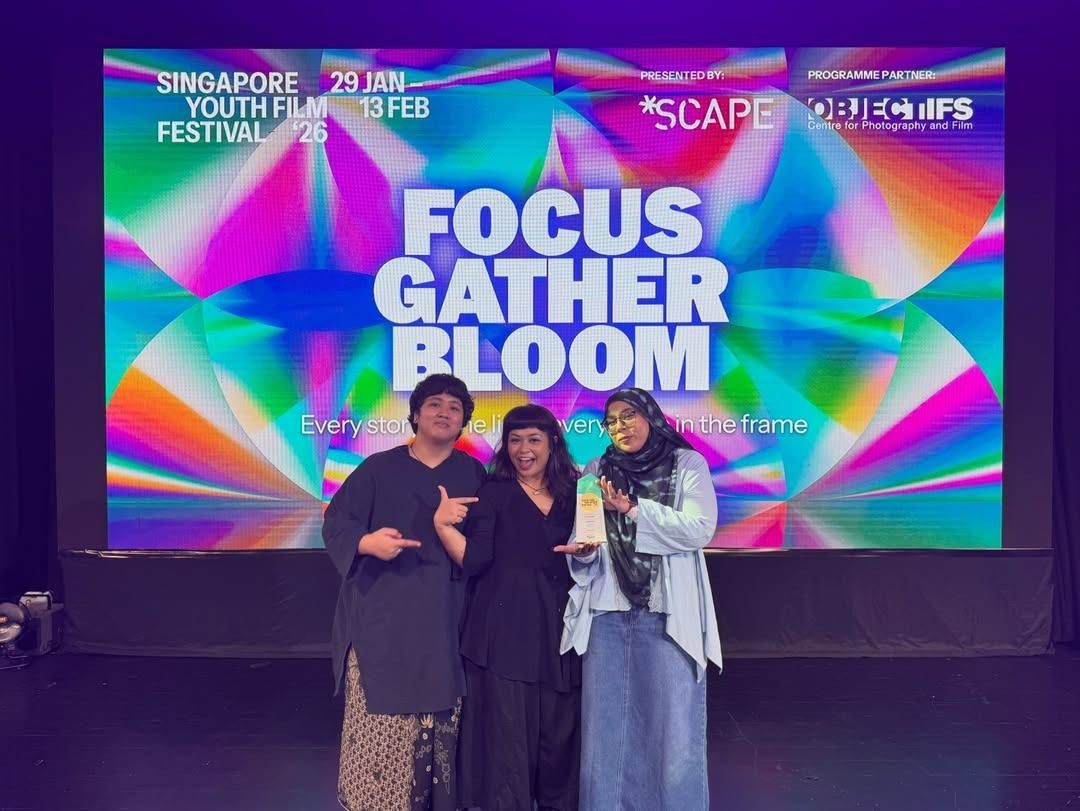
Attitudes towards both nature and women often mirror one another as both are expected to be tamed, beautiful, and controlled. Azina Binte Abdul Nizar’s short film, We Learn to Breathe in Distant Places , defies these expectations. Instead, it explores the tensions between the liberating respite nature offers and the suffocating confines of domestic life. The film was selected for this year’s Singapore Youth Film Festival, and was also part of Singapore International Film Festival’s Singapore Panorama last year.
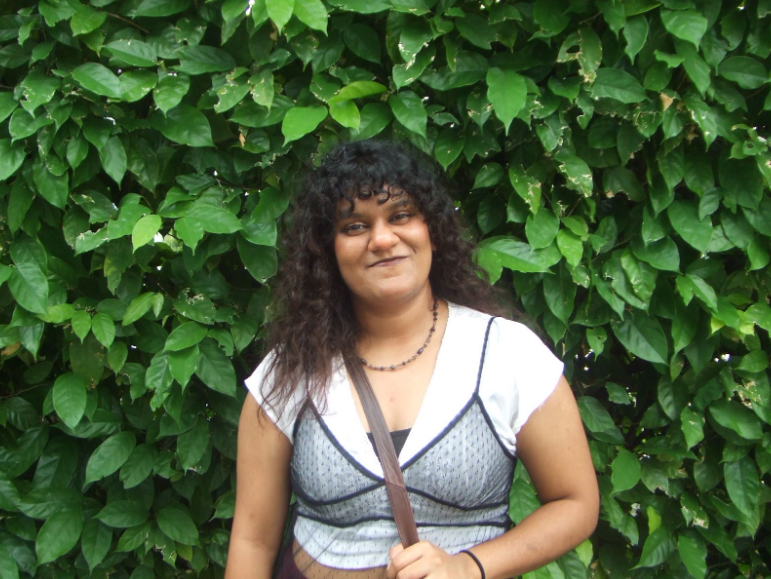
As an emerging artist-filmmaker, Azina’s practice revolves around her growing interest in the intersections between womanhood, nature, and identity, shaped by both her personal experiences and broader reflections on the environments we inhabit. In this conversation, she reflects on her creative process and the evolving ideas that continue to shape her work.
Phyllis: You studied film at Ngee Ann Polytechnic and are now about to graduate from NTU with a degree in English. How did moving from a film education to a literature-based discipline change the way you think about storytelling, structure, or character?
Azina: When you study film, much of the training is technical. Despite being exposed to different forms of cinema, the theoretical foundation isn’t always extensive enough to help you fully understand where your own interests lie as a writer and filmmaker.
Moving into literature felt like a way of deepening my research into the themes I was already drawn to. Seeing how different works across countries and time periods engage with similar questions has helped me better contextualise what I want to do with my own work. For example, when I’m engaged with African or South Asian Literature, I think about how these writers are able to talk about their specific and localised experiences in ways that resonate universally. Although I’m not directly influenced by it, I think their intentionality in their writing inspires me.
P: I was really struck by how We Learn to Breathe in Distant Places feels almost like a visual poem, particularly in its fragmented storytelling and careful attention to visual framing and sound. Could you share how the film first took shape for you? Was there a particular moment that made you realise this was something you needed to make?
A: With my previous works, I tried not to have linear narratives, and they were highly symbolic. After studying literature and encountering all these different works, I wanted to venture into something more narratively accessible to people, while also holding on to some part of myself within it.
I began thinking more about the idea of escaping and getting lost in the forest, so magical realism and mythicism were themes that first came to mind. I was also interested in engaging with the lived experiences of women and in how society stifles and restricts us, and I wanted to explore the kind of conversation I could have about all these aspects. That was how the film developed into what it became.
P: I saw that you mentioned in your interview with Catch.sg, that now you were thinking about whether it was ‘right to classify women in nature’ in your film and that you might have wanted to go beyond the nurturing aspect of nature and explore its grotesqueness. Looking back on it now, do you still relate to the film and the initial way you conceived it?
A: I definitely still relate to Distant Places , but for me, when I talked about how it would be interesting to explore the grotesque, I think it also comes from the idea of research. I don’t know how the story would have taken shape if I had done further research into how other writers engage with the grotesque or abject aspects of nature and femininity.
The film still stems from my personal experience as a woman and my desire to seek out nature to avoid engaging with society so actively. In nature, I do feel a sense of liberation, as opposed to an urban environment where everybody is enforcing all kinds of social conventions on me. That’s where the film came from, as I was trying to explore the natural environment as a site of escapism and magic.
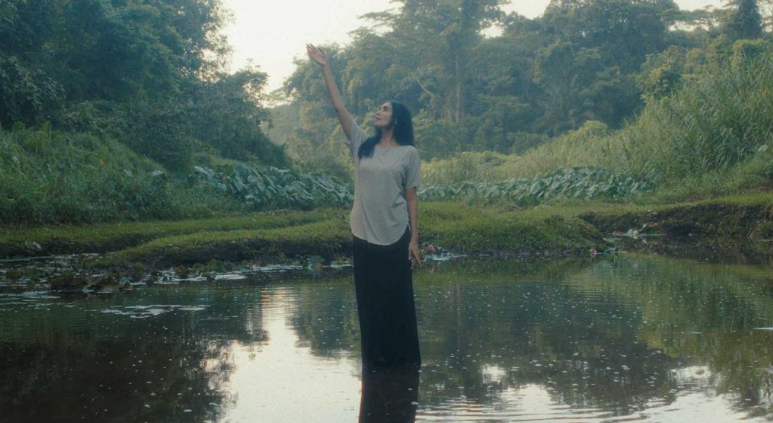
Opening of We Learn to Breathe in Distant Places (Credit: Azina Binte Abdul Nizar)
P: Thinking about the opening sequence of your film, with Mahia’s (Gurdev Kaur Sharma) dance in the forest, really stayed with me, especially with how you framed the natural environment as more than just a backdrop. I think that, alongside your amazing cast, nature feels like such an important character in your film. How do you approach representing nature in Singapore, where the landscape is often highly curated or managed?
A: When I engage with nature, I don't want to treat it as something inherently natural in Singapore. We always have this narrative of the “Garden City,” and Singaporeans have a strong sense of pride about it. But as you mentioned, it’s very curated, and we don’t acknowledge it. For me, nature is a site of freedom and authenticity, allowing us to be ourselves without any constraints. But given how curated and urban Singapore is, the country's relationship with nature is so complex. I think that when I explore these themes of magical realism and escapism, I am consciously reflecting on how the city is so different from the natural environment, and I want to explore this further in my future work.
P: Was the idea of portraying your characters in harmony with nature something you approached intentionally?
A: Maybe when I made it, it wasn’t completely intentional.
While writing and working on the film, I began to see nature not as a space but as a being in its own right. I think we have this tendency to other nature or treat it as a site of horror, and that fear comes from the fact that nature is an untameable force, and it’s something that humans can’t fully comprehend. As someone who is drawn to dismantling humanist ideas, of recognising that humans aren’t everything and that we don’t necessarily have power, I think engaging with things that are irrational and untameable is something I’m interested in, because the irrational holds some sort of comfort and some form of truth.
P: The idea of nature being irrational and combining that with the female experience is quite powerful. Is the female experience irrational and untameable for you?
A: I think society enforces all these classifications of women and men, and these labels exist because we are so desperate to make sense of ourselves. But that can also make things worse, because we aren’t creatures who live in ways that can be neatly classified — we are so complex. When we reduce our entire lived experience to a single label, we are actually restricting our lives into a very small bubble, and because of that, it becomes even more confusing. We become desperate to identify: What exactly is femininity, and who dictates what it is? Clearly, the patriarchy dictates what womanhood is, but if we take that away, what does it actually mean to be a woman?
All these questions become even more convoluted because there is a label put on us, and I think that is precisely what I’m paralleling in my film when I think about womanhood and nature. It’s the fact that womanhood is such an incomprehensible thing.
About the Author: Phyllis Chan is a writer-curator with an interest in the political margins of film and contemporary art. She was the co-curator of the Substation exhibition Between Lands: Migration as Transformation , as part of the Sub+ Youth Curators Programme. As a writer, she has contributed essays to Correspondence and NTU Film Society’s Exposure , with her work for the latter also featured in the Asian Film Archive’s Asian Cinema Digest .
This review is published as part of *SCAPE’s Film Critics Lab: A Writing Mentorship Programme, with support from Singapore Film Society.
Recent Posts