

Film Review #35: BURNING DAYS

Mei Qi Tan • April 12, 2023


Film Review #35: BURNING DAYS


*This film review may contain plot spoilers, reader discretion is advised.*

Photo credit: Rotten Tomatoes


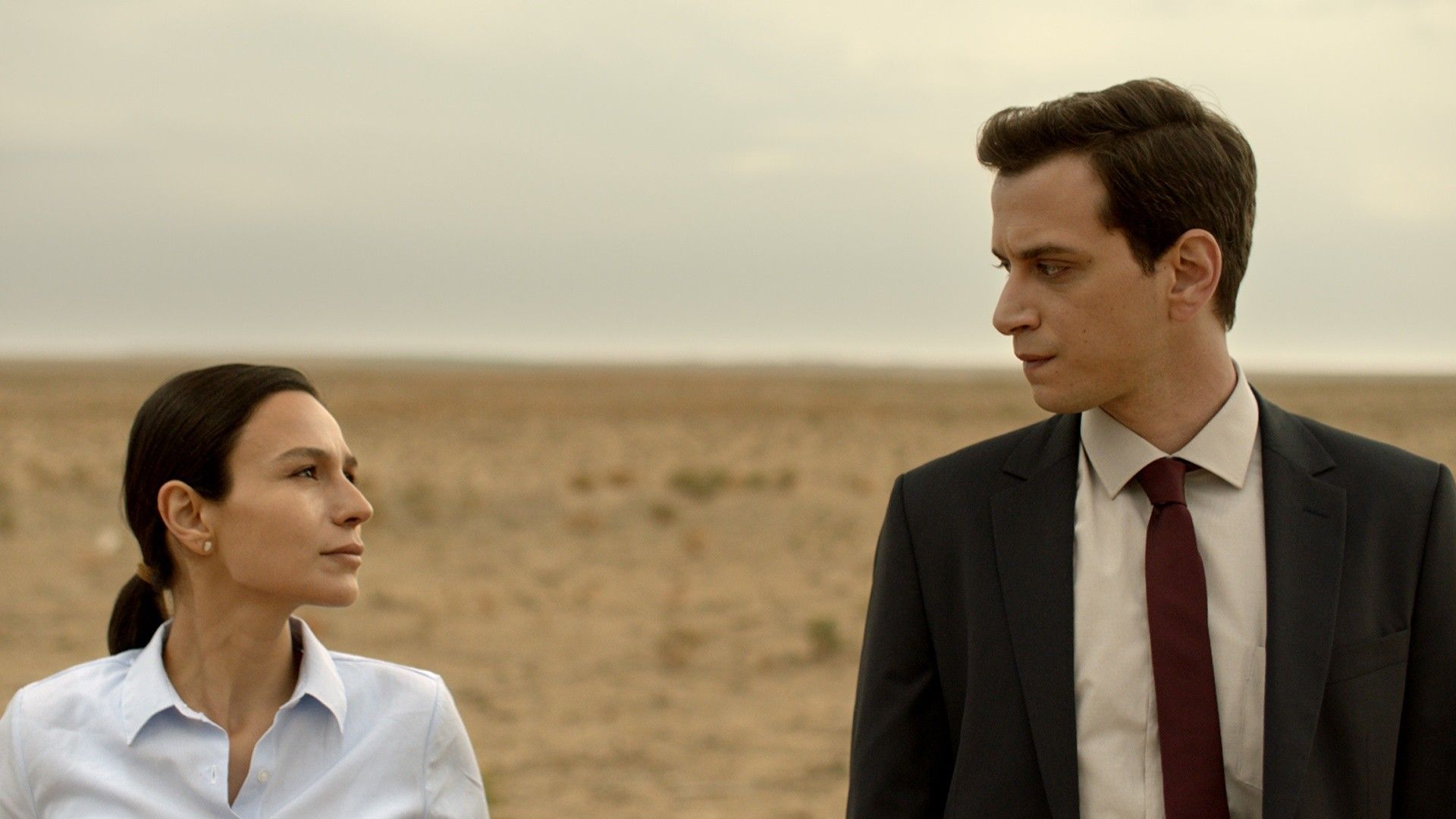
If you’ve ever had to watch or read any iteration of Henrik Ibsen’s An Enemy of the People, Burning Days (2022) will feel more than familiar. A young and strait-laced prosecutor, Emre (Selahattin Paşali), finds himself in rural Turkey as a replacement for his predecessor who left the post under mysterious and suspicious circumstances. Located in a desert that sees little rainfall, small-town Yaniklar’s politics are heavily shaped by the need for water. Against this backdrop, Emre’s job to investigate a sinkhole possibly caused by groundwater drilling and his power to stop the operation is sufficient to cast him out of the fold of the town’s goodwill. However, further cementing his alienation is his greater-than-thou view of the town’s parochialism and growing closeness with Murat (Ekin Koç), the editor of the town’s opposition press.


Unlike Ibsen’s play, water quickly fades out of the film’s concern when Pekmez, a local mentally-disabled Romany girl, is violently assaulted and raped. Emre dives headfirst into the investigation, only to be confronted by his possible involvement, which likely took place at a dinner with the mayor’s son, Sahin (Erol Babaoglu). But with his memories of the night fogged over by a raki-induced haze, he finds himself being pulled both ways by the shady testimonies of Sahin who affirms his complicity, and Murat who claims to be his alibi.


It is here that the film takes on a Nolan-esque arc à la Memento, the 2000 neo-noir mystery thriller. Punctuating Emre’s highly-disorienting flashbacks are scenes intercut by a darkness that hops in and out, alternately taking out and restoring Murat’s presence next to Emre each time our view becomes unobstructed. This sense of disorientation is heightened at the film’s climax, where flashlights carried by Sahin and crew create a strobe-like effect as they crest and fall with the characters’ running. This adds much flair to an otherwise extremely slow-burn thriller, a reward for the viewer’s patience with the almost torturous pace at which the film’s conflicts develop.


In an interview, Alper highlights that "[t]his film is completely about a society which is dominated by men and their inner conflict". This comes through in the stifling and claustrophobic feel that permeates Burning Days, with its artful flashbacks that keep us locked firmly within the recesses of Emre’s mental back-and-forth. The female characters, even with one of them being at the centre of one of the film’s many conflicts, are sidelined by the story. Judge Zeynep (Seli̇n Yeninci), who has not only learned how to play by the rules of her deeply misogynistic society, but also how to flourish under them, contains the potential of an interesting backstory, but remains overlooked and underdeveloped. Consequently, despite the film’s critique of a chauvinistic and patriarchal culture, it somewhat remains a product of that very culture.


But perhaps the narrow lens of Burning Days is the point. The hot, sandy lands that stretch out for miles in wide-angled shots are a fitting visual for the arid and lifeless environment created by toxic masculinity. Despite the expansiveness of both the setting and cinematography, the audiences are trapped, psychologically, socially and against their will, with the patriarchy in the enclosed and suffocating space of the film.


In an intense opening sequence featuring the spectacle of a local boar-hunt, a crane shot tracks the captured boar being dragged slowly through the streets by a jeep, leaving behind a disturbing, dark streak of blood in its wake. Alper constantly toys with the idea of the hunter versus the hunted—the townspeople against the boars, the prosecutor against the townspeople, and vice versa. It is an unsubtle metaphor, but with the rape and homoerotic subplot, a profoundly unsettling one that allows the film to capture the fear and anxiety of being queer or a woman in a society ruled by sexist and homophobic right-wing populism.


Though a curiously double-edged commentary on gender politics, Burning Days nevertheless remains an important rumination on increasing social and political conservatism in contemporary Turkey. What the film lacks in speed, it makes up for in style and an open-ended but satisfying conclusion.

——————————————————————————-


This review is published as part of *SCAPE’s Film Critics Lab: A Writing Mentorship Programme, organized by The Filmic Eye with support from Singapore Film Society and Sinema.


About the Author: When not deep-diving into the trove of queer Asian dramas and cinema, Mei Qi is busy wishing that Ghibli food was real.

BLOG

By Chinmaya January 28, 2026
Film Review #188: Bugonia
By Kaela Teh January 28, 2026
The Lost Youth and Digital Loneliness of All About Lily Chou-Chou
By Jing January 17, 2026
Seeing from a Distance: Modern Life through Edward Yang’s Lens in Yi Yi
By Rachel Xia January 17, 2026
Is the Person You Once Loved Still by Your Side? 那个曾经深爱的人还在你身边吗? A reflection on Once We Were Us 观《Once We Were Us》有感
By Han Yiheng January 16, 2026
Commentary: Agnès Varda’s Lessons in Humility
By Jun Sen January 15, 2026
Covert Operations, the Liberation of Truth and the Need to Remember – The Universal Rebellion  Seen in The Secret Agent
By Stephanie December 31, 2025
Feeling Death: Review of Kiarostami’s Taste of Cherry (1997)
By Ivan Chin December 31, 2025
Film Review #182: YI YI
By Jing December 16, 2025
The Music of Memory: Form, Intimacy, and Musicality in Joachim Trier’s Sentimental Value
By Jarrett Yang December 16, 2025
SGIFF Film Review - Amoeba (2025) 
More Posts