Film Review #193: Following
“Why does she have so many pictures of herself?” – Piecing together
Following
(1998)
*SPOILER WARNING: THIS ESSAY SPOILS THE ENTIRE FILM. TURN BACK NOW IF YOU HAVE NOT SEEN THE FILM!*
I watched
Following, Christopher Nolan’s 1998 debut, for the first time last year. The film’s final plot twist, in which the true plans of the well-dressed burglar Cobb (played by Alex Haw) are revealed, struck me immediately as being a trifle overwrought. After I finished watching the film, I rushed to connect the dots in order to make sense of the ending. I tried to replay the film mentally from Cobb’s point of view and to rearrange the film’s non-linear narrative in a traditional linear form. I then re-watched a large number of scenes in order to check my “solution” for errors. I also enabled the subtitles, all the better to detect bits of dialogue and exposition that I might have missed during the first viewing.
My feelings were mixed as I put on the film again. I knew I wasn’t re-watching key scenes for reasons to do with cinematic appreciation. I simply wanted the satisfaction of knowing that I had successfully solved the film. In short, I found myself engaging with Following not as a film, but as a puzzle. I can’t say I was surprised by my reaction to the film. I do recall engaging with
Memento,
Inception, and
Tenet in a similar fashion. It was quite bracing to realize that Following , a lean 70-minute crime film shot on a $6000 budget, could draw me in in the same way that Nolan’s more expensive films had done.
I have always thought of Christopher Nolan as the Christoper Priest (the late author of The Prestige, which Nolan adapted into a 2006 film) of films. To put it a little more strongly, I can’t help but wonder if Christopher Nolan has been emulating Christopher Priest throughout his whole career. Like the novels of Christopher Priest, some of Nolan’s films are set up as puzzles. This may explain the common observation that Nolan’s films are “cold,” an observation that I happen to agree with. But the puzzle-like quality of some of his films also explains their popularity. There is obviously a large mainstream audience for his puzzle-films, as evidenced by the large quantity of online commentary on how the dots laid out in his films should be connected.
How does
Following
rate as a puzzle? For me, some of the key pieces don’t seem to fit that well together. That’s a roundabout way of saying that I felt there were some parts of the film that felt implausible. But the pieces do more or less fit together if you take the film on its own terms, which involves assuming that the consequences of the actions taken by the characters are somewhat unavoidable. Interestingly, it seems to me that
Following doesn’t want you to have to make such assumptions. Following strikes me as self-consciously logical and correct. In other words, it makes it a point to tell you – usually via exposition – that the moving parts of the plot do fit together in a logical manner. I found this to be a little grating, but I wasn’t surprised to see it. There is a lot of exposition in Nolan’s films. It’s hard to set up a puzzle or to lay down and engage with the rules of a game without exposition. Although I prefer showing to telling, on some occasions I have actually found Nolan’s use of exposition to be tolerable and effective. Sometimes, though, this storytelling quirk leaves the seams brutally exposed – as can be seen in
The Dark Knight Rises (2012), but that is another essay waiting to be written.
These quibbles aside, I felt compelled to put the pieces of Following together immediately after my first viewing, even the ones that, in my view, didn’t fit very well. It helped that the film was only 70-minutes long. This meant that rewatching parts of it didn’t take a lot out of me. Also, the self-consciously logical character of Following made the task of re-watching certain scenes in order to check my solution to the puzzle a simple one. The dots and the connections between them are visible enough, particularly when the subtitles are turned on, for the determined viewer to spot, though this may be gratingly so in certain parts of the film for those of us who prefer more subtlety. Consider the following examples:
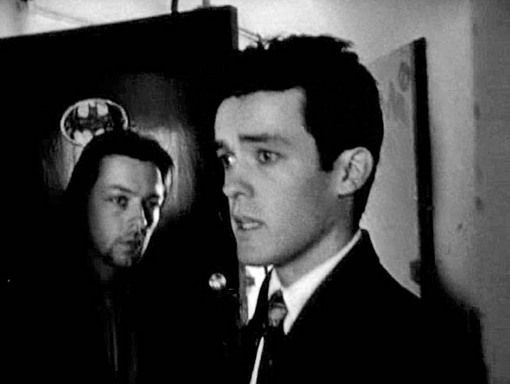
One crucial dimension of Cobb’s plan requires Bill (played by Jeremy Theobald) – who appears in the credits merely as “Young Man” – to develop a fascination with the Blonde (played by Lucy Russell) and to steal and store some of her personal effects. Cobb engineers this by breaking into the Blonde’s flat with Bill in tow. Bill does not know at this point in the film that Cobb and the Blonde are setting him up. Pictures of the Blonde have been strategically placed all over the flat, all the better for Bill to see them and develop an interest in the Blonde. The plan works. More specifically, the script tells us that it works. Bill says aloud twice during the break-in that he has noticed the pictures. “She’s got pictures of herself everywhere,” he says. “Why does she have so many pictures of herself?”. Cobb also draws Bill’s attention to the Blonde’s beauty several times during the break-in. “She’s a fox,” he says, as he rummages through her underwear. “She looks good.” “Look at her. She’s a babe.” “I think she’s a model. She’s certainly vain.” One cannot help but feel that these lines are as much for the audience as they are for the characters. “God, it’s perfect,” Cobb later tells the Blonde. “The photos worked.” But should they have worked? It is easy to join the dots on the film’s terms. Bill follows people around London. He is lonely and unemployed - an “unemployed 20-something who fancies himself a writer.” Cobb weaponizes his knowledge of these things by ensuring that there are many pictures of the Blonde in her apartment. Lonely Bill sees the pictures, starts to follow the Blonde, develops a romantic interest in her, and falls into Cobb’s trap. This feels too easy. But the thinness of Cobb’s manoeuvre is masked by the script’s insistence on its success.
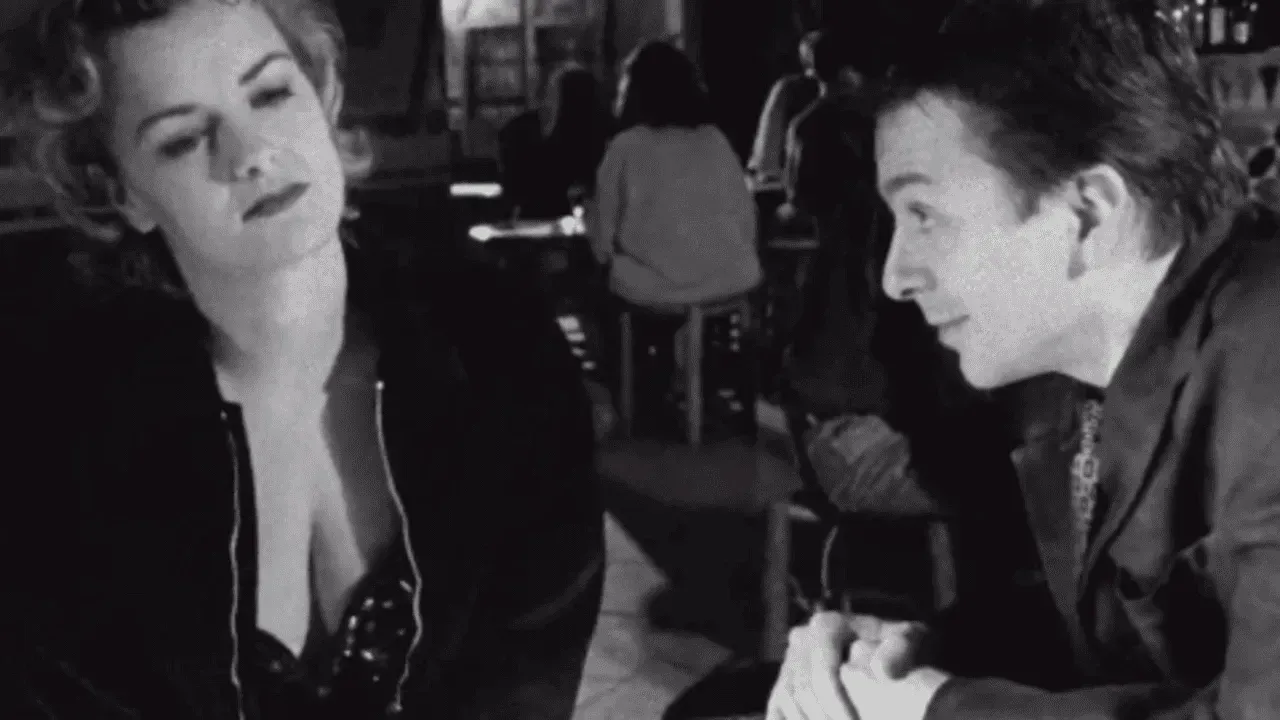
The final twist at the end of the film reveals that Cobb is setting both Bill and the Blonde up. Cobb has been paid by a crime boss (the “Bald Guy”) who’s being blackmailed by the Blonde to murder her, and he intends to frame Bill for the crime. We learn, in an exposition-heavy scene near the end of the film, that Cobb has concealed his true intentions by telling the Blonde a different story. The Blonde thinks that Cobb is simply using Bill to throw the police off his scent. Cobb has told her that he found the body of a murdered old woman during one of his break-ins and that someone had seen him leaving the dead woman’s flat. The police have already brought him in for questioning, during which he told them that it was someone else at the flat. Cobb’s plan, as understood by the Blonde, is for Bill to be seen as this other person in order to free himself from suspicion. This requires that Bill should roughly look and behave like Cobb. To this end, Cobb, who burgles flats in a suit, inducts Bill into the life of a burglar – in effect, making Bill adopt his MO – and even persuades Bill to get a “new haircut” and a “new set of clothes.”
I was simultaneously thrown off and fascinated by this exposition-heavy scene. I was thrown off because I found it hard to believe that the Blonde would fall for such a tale. At the same time, I was struck by the self-consciousness of this scene. It is almost as if Christopher Nolan knows what the audience’s likely objections will be and wants to pre-empt them with a mini-FAQ. One objection would be that Bill, even with his new haircut and clothes, still doesn’t really look like Cobb. The Blonde asks Cobb if the person who saw him leave the dead woman’s flat managed to get a good look at him. “No,” he says. “Which is why I think this is going to work. All we need is someone of roughly the same appearance, roughly the same way of working, and we should be fine.” When the Blonde suggests that Cobb should simply tell the police that the woman was dead when he found her, he highlights several reasons why that wouldn’t be enough to free him from suspicion. And what if Bill’s got an alibi, she asks? “Well,” Cobb replies, “he’s a loner. He’s perfect. Even strangers that have seen him before aren’t going to recognize him because he’s had his hair cut.” I remember wondering for a moment if haircuts could really be so potent. Such lines are as much for the audience as they are for the characters. The film is making it a point to tell us that it is internally consistent and logical.
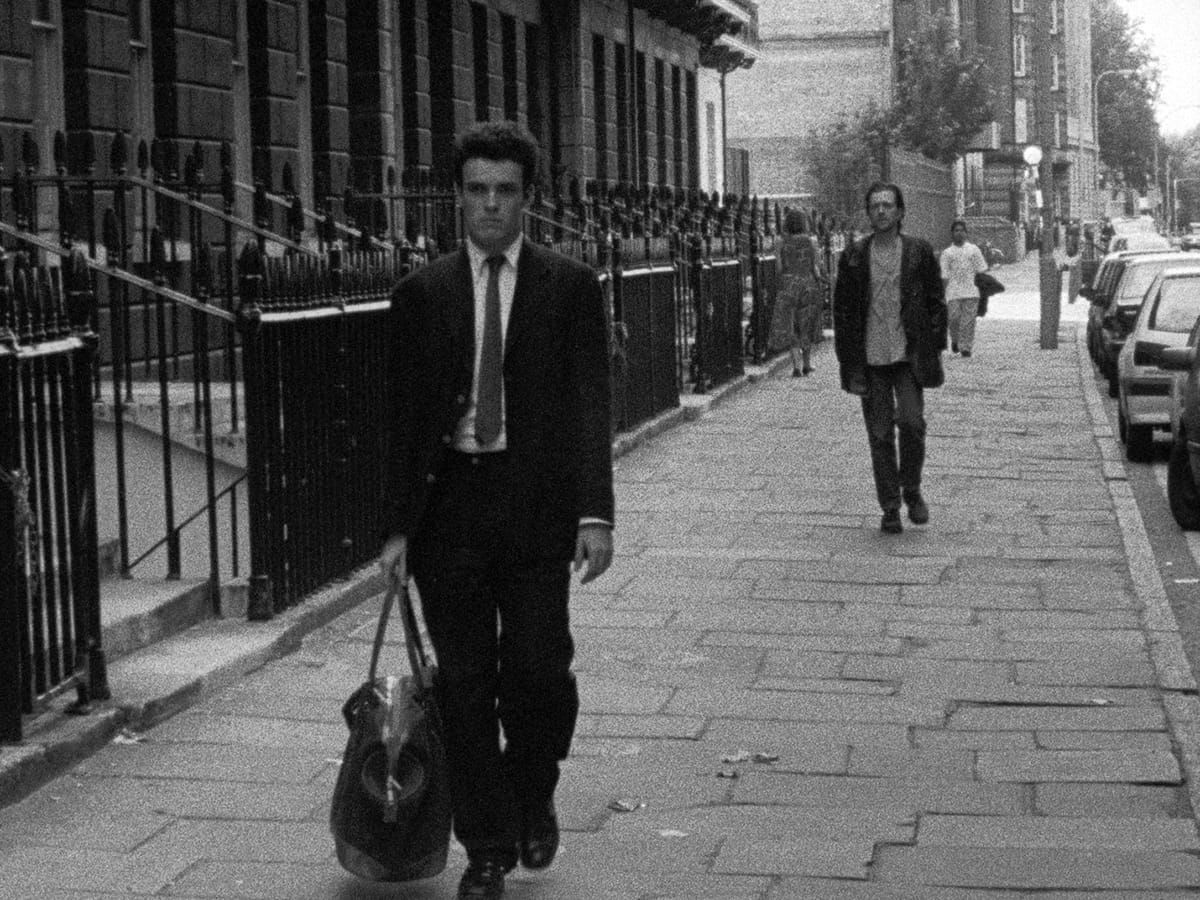
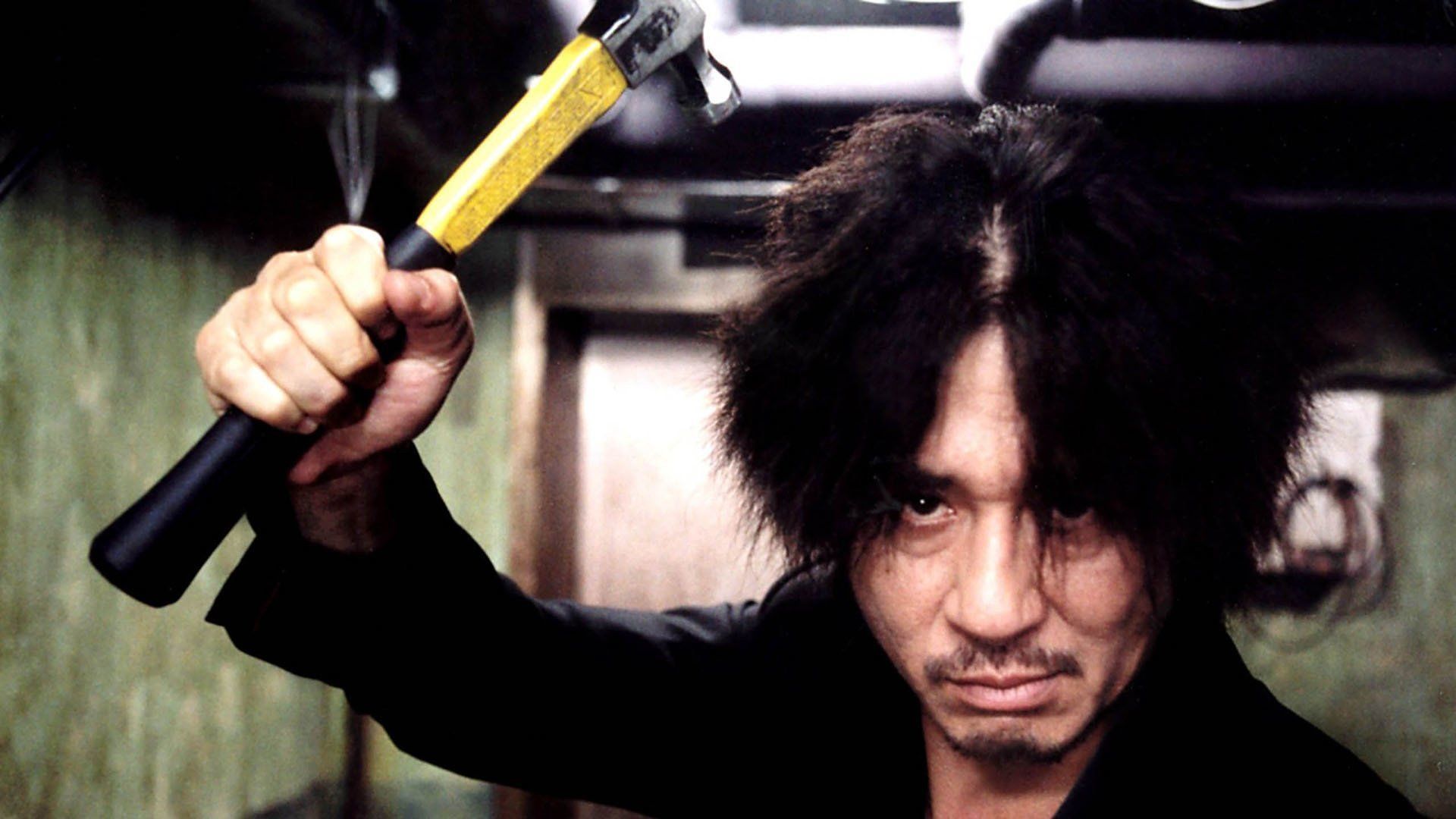
There is a scene in the first half of the film that seems a tad unnecessary when taken on its own, but which makes sense when one takes into consideration the film’s approach towards accounting for its moving parts. Bill, having heard from the Blonde that the Bald Guy has been blackmailing her with photos of a pornographic nature, has decided to break into the Bald Guy’s club to steal the photos. He phones Cobb for advice on self-defence. Cobb reels off a selection of weapons, one of which – a hammer – catches Bill’s attention. There is something perfunctory and utilitarian about this scene, which seems to serve the purpose of telling the audience to pay attention to the hammer. This weapon later plays a role in Bill’s downfall. Bill successfully steals the photos, as well as a large amount of cash, from the safe in the Bald Guy’s club. He also takes out one of the Bald Guy’s men with his hammer. Back at this flat, Bill realizes that the photos are harmless modelling pictures. Realizing that he’s been set up, he confronts the Blonde in another exposition-heavy scene. The Blonde calmly gives up the game (as she understands it): “The police think he [Cobb] did something, and he didn’t. So he needs a decoy, another likely suspect. Someone caught robbing a place using the same way he does it, his methods.” This scene spotlights Bill’s hammer and what he did with it very explicitly: “He came in. He went down. I didn’t hang around long enough to find out whether he could get up. It’s his blood on my hammer. How could you do this to me?”
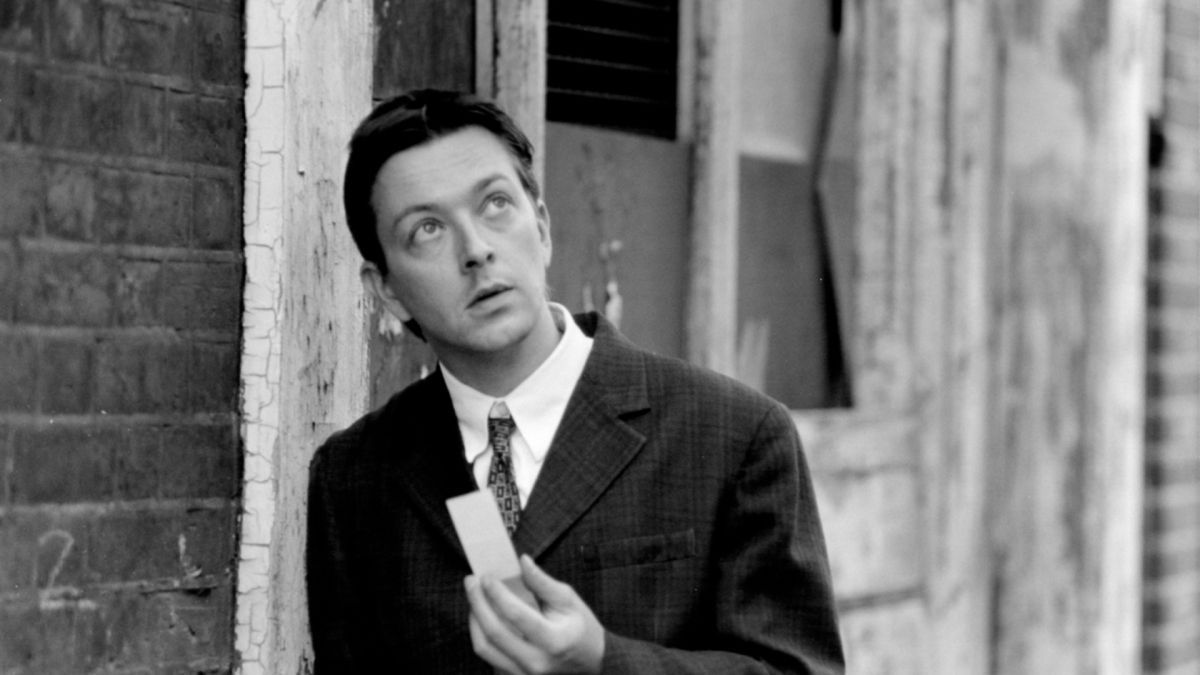
After confronting the Blonde, Bill heads off to the police to tell them “the truth.” Cobb, meanwhile, murders the Blonde with Bill’s hammer. At the police station, a policeman tells Bill that “we don’t actually have any unsolved murders of old ladies” and ties him to the Blonde’s death, pointing to, among other things, a shoebox taken from under Bill’s bed that contains the Blonde’s personal effects and the blood-stained hammer used in the Blonde’s murder. “We also found a hammer with two types of blood on it,” he tells Bill. “One type I assume will match the bloke you put in hospital.”
I can’t say that the ending is watertight. Why did Bill leave his blood-stained hammer – an important piece of evidence – at the Blonde’s flat? Was Cobb simply being opportunistic when he used Bill’s hammer to murder the Blonde? Or had he been banking on the possibility all this time that Bill would take his weapon to the Blonde’s flat and leave it there? Following is a film that consciously tells its audience what is going on and how the pieces fit together, but this doesn’t mean that all the pieces of the puzzle really do fit snugly with each other. It is, though, an excellent introduction to Christopher Nolan’s storytelling quirks. It has the same expository, telling-rather-than-showing, and self-consciously logical qualities of his other films. Of course, in the case of Following , one should make allowances (perhaps a very generous amount) for the fact that it was a micro-budget film ($6000). Telling, after all, is far cheaper than shooting more scenes for the sake of showing.
About the author: Benjamin Choo is a Senior Lecturer at the Singapore University of Social Sciences. He has been contributing to the SFS blog since 2024.
Recent Posts