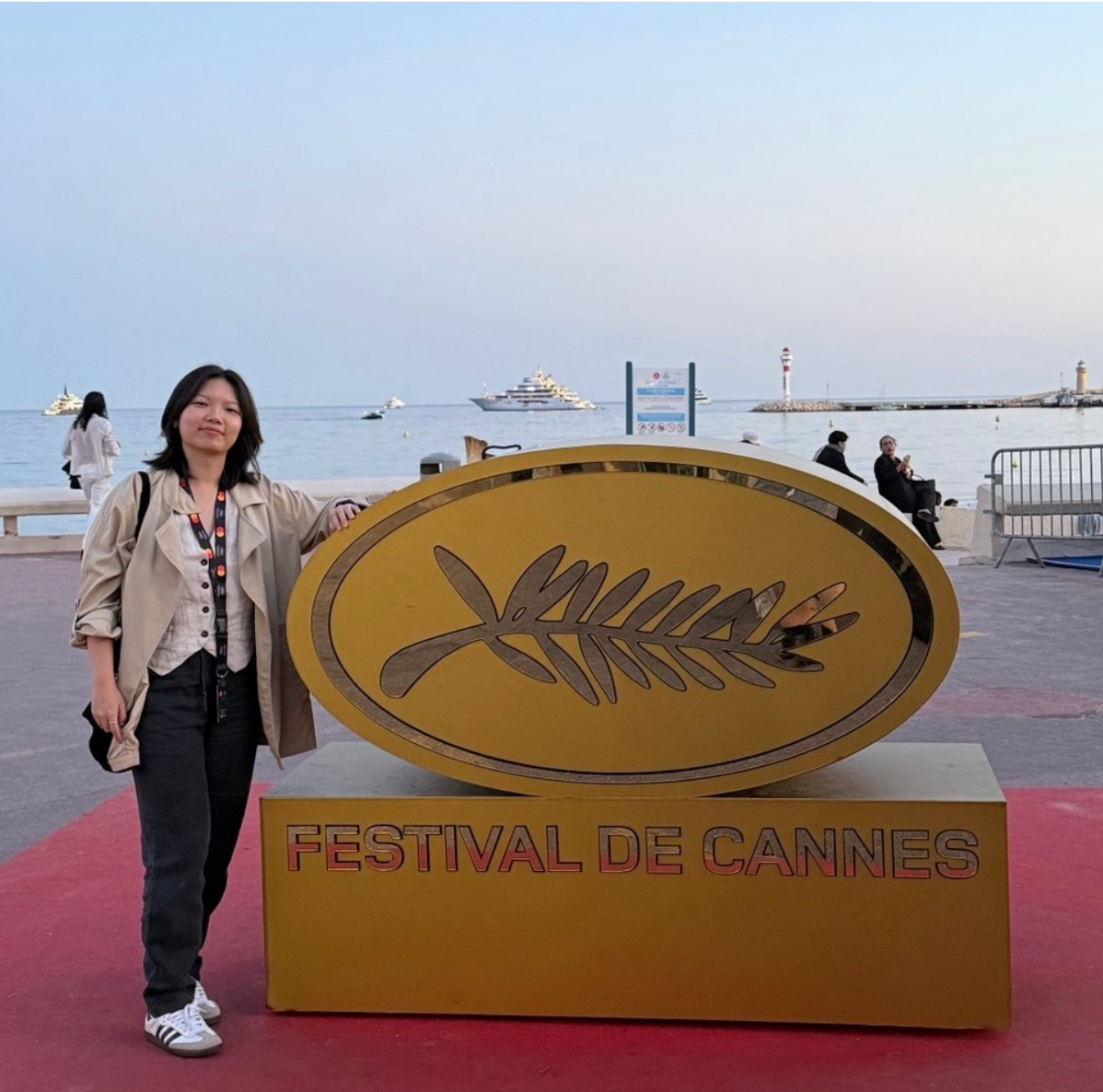
This year, I had the privilege of attending the 79th Cannes Film Festival, courtesy of their
3 Days in Cannes programme. Unlike industry professionals and the actual glitterati, who were occupied with meetings and conferences, my only agenda at Cannes was to JUST WATCH FILMS.
Given that I had once felt an overwhelming sense of guilt for spending 3.5 hours of a lovely Saturday afternoon watching a single film (I’m looking at you,
Jeanne Dielman, 23 Commerce Quay, 1080 Brussels)¹, my Cannes itinerary truly felt like a luxury. After all, for us productivity-pilled and efficiency-maxxxing Singaporeans, the idea of spending our precious leave days watching films (overseas, no less) seems slightly absurd.
Nonetheless, I was happy to break convention in this instance. As a film-enjoyer, it was an absolute dream to be able to devote 96 hours to this medium I love dearly.
According to the Cannes rules, feature films are works that run at least 60 minutes or longer, and this year’s official selection included 22 films in the main competition category, 19 films competing for the Un Certain Regard awards, and 22 non-competing films premiering at Cannes.
Personally, I was most looking forward to watching:
- Teenage Sex and Death at Camp Miasma
dir. Jane SCHOENBRUN
- All of a Sudden (Soudain) dir. HAMAGUCHI Ryusuke
- Fjord dir. Cristian MUNGIU
- Bitter Christmas
(Amarga Navidad) dir. Pedro ALMODÓVAR
- Hope dir. NA Hong-Jin
In this respect, I think I found some success - I managed to watch 12 films in the span of four days, (I could collect my pass and access the festival a day before my ticket-bidding ability was activated) with a total runtime of 1556 minutes (approx. 25 hours 56 min). Although I didn't manage to get tickets for my top pick (Camp Miasma), I was fortunate enough to watch most of the other films I had shortlisted.
In particular, Hamaguchi’s film alone clocked in at 196 minutes, surpassing his previous Cannes darling,
Drive My Car
(2021), which spanned 179 minutes.
Temporal vacuum aside, the 12 films I watched took me on a truly international journey. They were set across three continents, and the countries they featured included the US, Nepal, Spain, Norway, France, Germany, Japan, and South Korea. Only 3 films contained English dialogue, and of these, only one featured English as the sole spoken language.
With this diversity in language and culture came the diversity of ideas.
This was perhaps the starkest difference between the Cannes official selection and the local mainstream programming back home in Singapore. At Cannes, the usual Hollywood blockbusters were absent, and what some would deem Second, and (arguably) even Third, Cinema took centre stage².
Not only were the 12 films I managed to watch at Cannes stylistically distinct, showcasing each auteur’s unique visual language (and approach to pacing), they also featured narratives with more complex themes and tropes. For instance, a handful of these 12 films tried to grapple with existential themes like “the dignity of life” and “reimagining society”, while others explored more relational topics (that are equally nuanced) like “parenthood”. It is also worth mentioning that 7 of the 12 films I saw featured queer themes and/or non-traditional family units. These ideas felt like a world apart from, and even revolutionary in contrast to, the traditional themes of “good vs evil” and “love conquers all”, as well as the heteronormative and patriarchal ideas that we see so often in Classical Hollywood Cinema.
Although auteur cinema and arthouse cinema may be written off by some as slow-paced and even “boring”, perhaps there is something to be said about how the themes, narratives, and perspectives explored in these films are more unique and sometimes even enigmatic. I would like to imagine that certain narratives Hollywood shies away from can only be handled with sufficient care if they (and the audience) are given enough time to breathe.
In some sense, I do also appreciate the defiant quality of making an audience spend (almost) inordinate amounts of time sitting in a dark room and viewing your work, rather than, say, reading emails.
At the end of the day, when one’s worth is often measured by economic output, deciding to spend time watching films instead of increasing shareholder value is, in itself, a small act of resistance.
Suffice to say, I thoroughly enjoyed my time at Cannes, and I would encourage other film-enjoyers (within the programme’s age bracket) to take this opportunity to widen their cinematic horizons, and through this three-day film immersion, perhaps attempt to reclaim the concept of “leisure” through film.
Anyway, without further ado, here is my personal ranking list of the films I watched at Cannes:
- All of a Sudden (Soudain)
- Elephants in the Fog
- Coward
- Fjord
- Sheep in the Box
- Garance
- The Man I Love
- Bitter Christmas (Amarga Navidad)
- Hope
- Everytime
- Diamond
- The Unknown (L’Inconnue)
Do click on the movie titles above if you are interested in reading my reviews for (1)
All of a Sudden, (2)
Elephants in the Fog, and (3)
Coward.