Disclosure Day: A Defence and Autobiographical Reading
“a generalized plea for cross-species understanding that, even bolstered by the reliable stirrings of a John Williams score, left me dispiritingly dry-eyed.” — Justin Chang, New Yorker
There seems to be a sense of cynicism regarding Steven Spielberg’s latest movie,
Disclosure Day, starring Emily Blunt and Josh O’Connor as Margaret Fairchild and Dr. Daniel Kellner respectively, who form the key to exposing the world to the existence of extraterrestrial life. Is the movie's view on such a disclosure much too simplistic and sentimental? I would say yes. But to focus on the film in relation to the ‘state of the world’, or its political messaging, would be to miss much of what the film has to give us.
For one, we do not level this same criticism against films which operate on escapism, films that may be detached from the everyday world and offer no statements, but in that very lack of commentary represent an implicit political statement, usually one of indifference or acceptance of the status quo. A more valid criticism would target the Christian bias of Spielberg’s religious ruminations within the film. When Daniel’s girlfriend (played by Eve Hewson) initially hears about his plans for exposing the existence of extraterrestrial life, she protests about how this knowledge would be a global crisis as it disrupts the special place of Man in the Universe. As an audience member from a non-Christian majority country, this theological claim is peculiar and generates little tension in the scene because it has no bearing on a religion like Buddhism, for example. I would argue, however, that both the political optimism, and the theological naïveté of that initial argument, are mediated and justified when reading this film through an autobiographical lens. A clear line can be drawn from a well-hidden discussion of childhood upbringing up to Spielberg’s views on both the magic of cinema and his role in the filmmaking process.
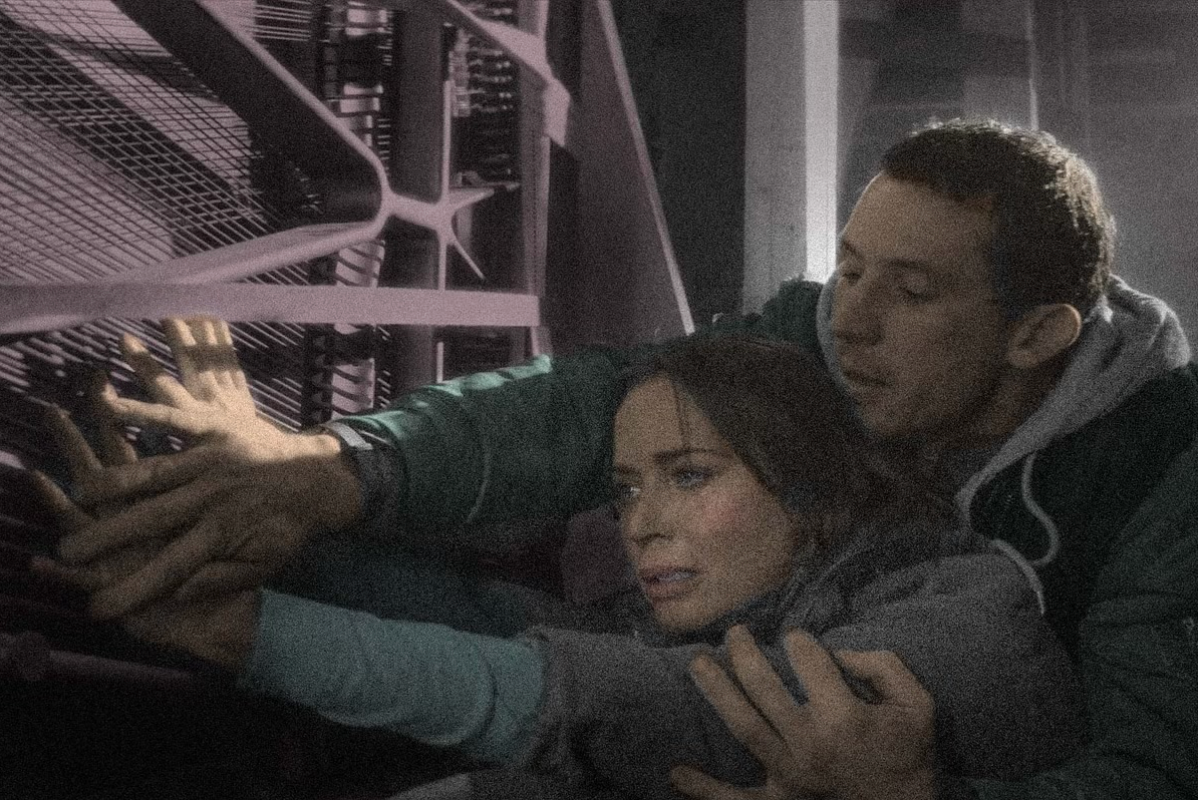
First, one needs only to look at the panic attack scene in the railroad car. Hollywood usually has a very immature, flashback-heavy perception of how childhood trauma operates, but here, both the filmic structure and the construction of the scene itself display a sound understanding of its mechanics. The panic attack occurs right after possibly the most exhilarating action set piece in the film. If that wasn't enough to draw the audience’s attention away, within the carriage is an incessant rumbling, full of the discordant harmonies from musical instruments on racks (see Fig. 1). Structurally and sonically, an attempt is made to
conceal
the sudden non-sequitur, epiphanies where Margaret cries out on how her shaking hands remind her of her Dad's Parkinson’s, followed by the admission that she ran away from home¹.
Astoundingly, this conversation is never touched on again for the rest of the film. I'm not trying to draw a reductive equivalence here between Margaret and Spielberg, but merely suggesting that this film is more than simply a conspiracy thriller or a first-contact sentimental picture. Spielberg self-inserts and later almost tries to hide an attempt to bring up childhood trauma, a topic more overtly covered in his previous
The Fabelmans
(2022).


Fig. 1 (Credit: United International Pictures)
***SPOILERS AHEAD***
I would also like to call for another redirection of attention, for the climax is not the disclosure but the sequence that occurs immediately after in the reconstructed house. Before this scene, Hugo Wakefield (Colman Domingo), the head of the defectors from the organisation that is trying to cover up the existence of aliens, is always depicted in the midst of people moving props and constructing a house in the middle of a large warehouse. From the beginning, Spielberg is already hinting at an impending meta-cinematic exploration. When it
does happen, Spielberg embarks on a similar operation as he did in
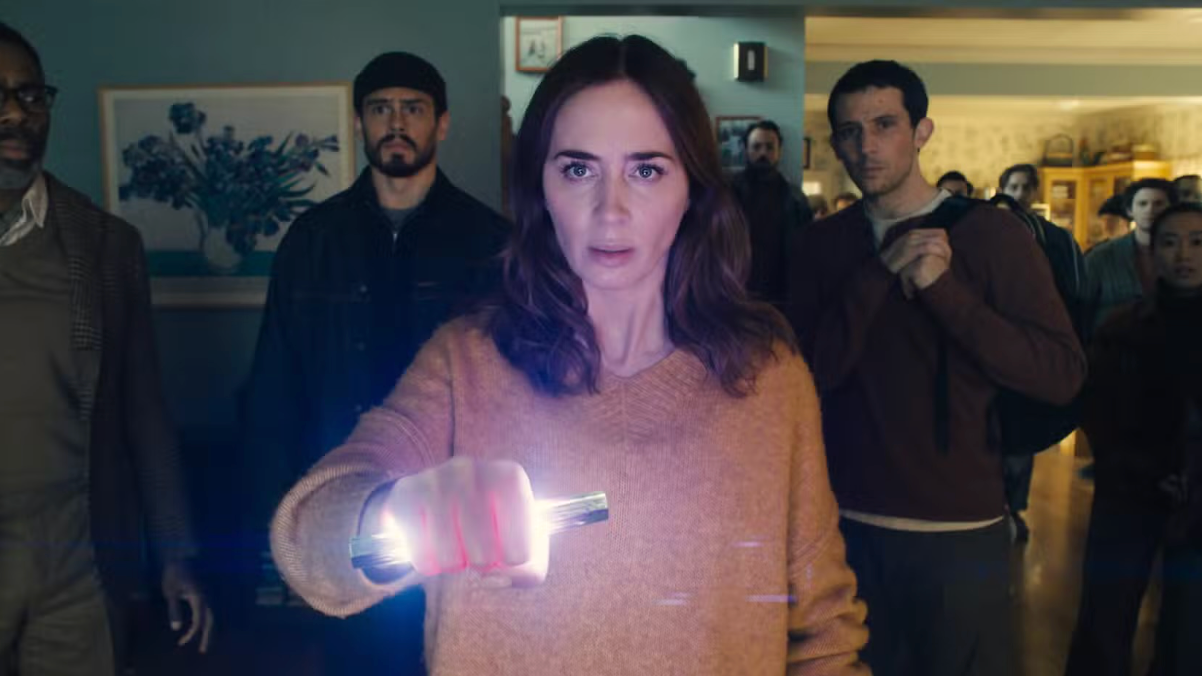
The Fabelmans. Similar to Sammy’s necessity of capturing images through his film lens, his two protagonists only finally realise what really happened when they hold what Hugo previously described as a “magic wand" (magic of cinema?), inhabit the film set within a film set, and replay their first contact (See Fig. 2). Both scenarios use different perspectives to explore the capability of cinema to enable communication and uncover truths. Seeing these actors walk inside the set-within-a-set and rediscover themselves, the audience feels the cathartic release. They identify with that feeling of expansion of the possibilities of articulation Spielberg had during his formative experience as a child watching Cecile DeMille’s
The Greatest Show on Earth
(1952), which remained latent and was subsequently re-realised in totality through
Jaws (1975), 23 years later.

Fig. 2 (Credit: United International Pictures)
Following this thread, I believe the need for two protagonists to act as two intermediaries for communication from aliens to humans becomes an implicit commentary on how Spielberg wants to view cinema. In the film, Daniel is the receiver who recognises the alien’s mathematical clicks and gurglings (input) as language, and Margaret, the amplifier, who, with the power of empathy, can communicate this language globally (output). In relation to the genre elements and the overt story, Spielberg could have easily made do with just one protagonist to act as the ultimate intermediary. This would also have been in line with the secular messianic figure trope that has an established tradition in Hollywood (Neo in The Matrix franchise, John Connor in the Terminator franchise).
A possible interpretation for this plot element is that the structure in which alien language is ‘translated’ into human language mimics the process of cinema as starting from a pool of experiences and ideas, to the ambition of the auteur, then by amplification through the distributor² before being projected to the world. In a sense, every few years when crowds flock to watch Spielberg’s latest film, we are watching yet another disclosure of his mind. If anything, the optimism and sentimentality here are not about how the world will react to the existence of aliens; instead, it ties in directly with his lifelong fascination with cinema and, in the hope of faithfully conveying his vision, his ideas, from the camera lens to the theatre screen in an attempt to bring people together and elicit a collective, emotional response. When one imagines an arc from Spielberg’s childhood preoccupations with cinema up to his general sentimental lens on the magic of cinema, the ending scene of people worldwide glued to their phones watching the news then seems more in line with his hope for the power of cinema as a form of universal communication rather than a naive scenario of what would happen if the world found out about extraterrestrial life.
¹Let us recall Spielberg on Catch Me If You Can (2002), “I ran away from home when my parents got divorced; at the same age Frank ran away when his parents got divorced, so I had that in common with him.”
²There is typically another important intermediary – the producer(s). I have omitted that here because since E.T. the Extra-Terrestrial (1982), Spielberg has produced most of his films.
About the author: Chengsheng is a cinephile whose low attention span causes him to watch much too many short films (Kenneth Anger, Agnès Varda, or Vittorio de Seta are some favourites!). Other hobbies include reading continental philosophy or listening to classic rock on vinyl. Chengsheng is always looking forward to making new friends and can be found on both Letterboxd and Instagram as @arcyeus.