Interview with The Creators Behind ‘Mountain Mountain’
Interview with The Creators Behind ‘Mountain Mountain’
By Lixin Foo
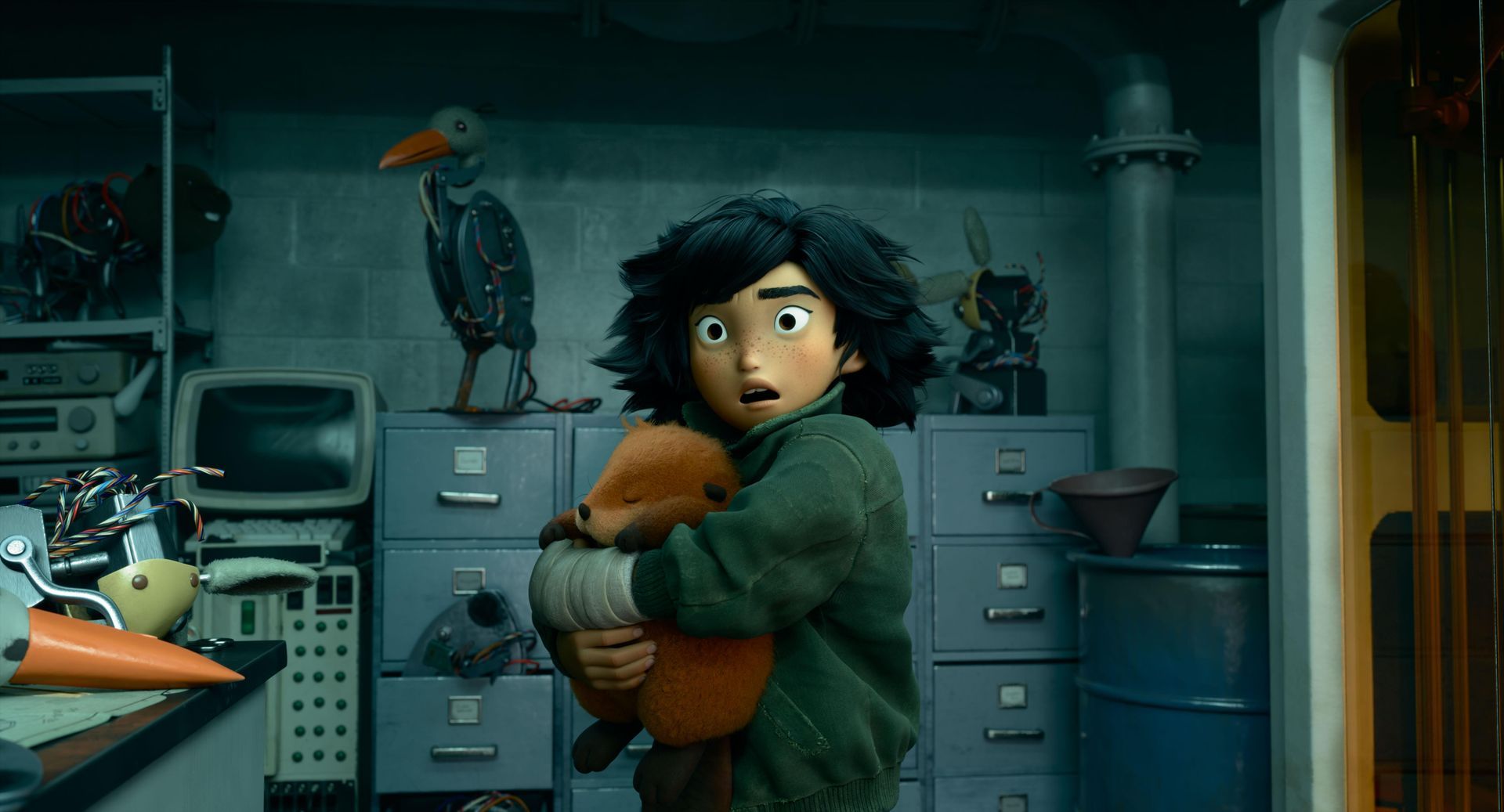
MOUNTAIN MOUNTAIN (2026), courtesy of SYFF
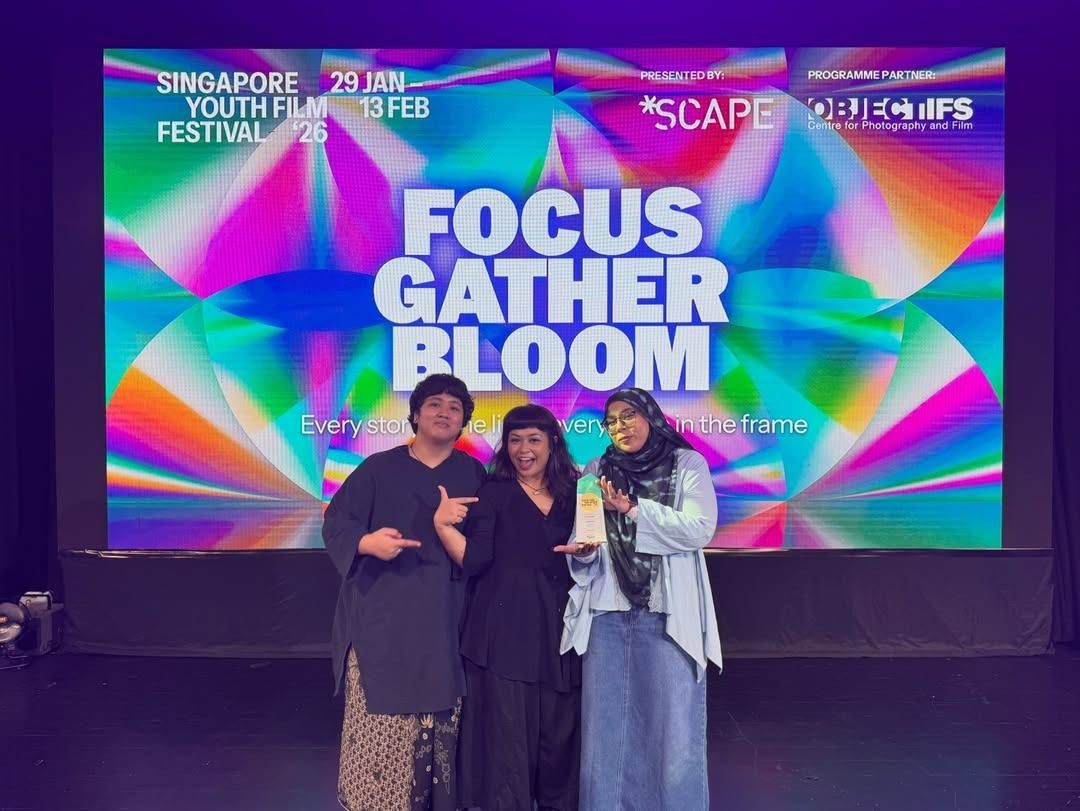
The animated short film Mountain Mountain premiered at this year's Singapore Youth Film Festival (SYFF), where it was nominated for Best Short Film and won the Best Editing Award.
In Mountain Mountain, two young adults ride a cable car up Mount Faber in search of mountains in Singapore. During their cable car ride, they recall stories that reminisce about the mountain they search for, unsure of what they will find.
I met the creators behind the animated short film Ben and Grace, for a virtual interview to learn more about their journey as animators and their inspirations. The audio can be found here, or on Spotify under SFS’s podcast, SFS Screencap. The transcribed version below has been edited for clarity.
–
Lixin: Hello, hello! Thank you for taking the time to sit for this interview. To start things off, I'd like to ask — what's something that you're excited about in your life right now?
Grace: I think what I'm most excited about now is doing art in my own time. Because my first serious experience with art was in university, and that really changed my idea of art — because I had to study it. But now that that's over, I'm really rediscovering what it means to do art for myself and in my own free way. So I'm very excited about trying new things and seeing the world, then seeing how I can interpret the world through my art in different ways.
Ben: I recently played a few shows with a local band, who are some of my dear friends. Besides that, I've been job hunting while building my portfolio, doing new illustrations and drawing a lot, like what Grace is doing.
Lixin: That sounds very exciting and I hope that both of your job hunts go well. Filmmaking is a somewhat unconventional vocation in Singapore. What made you decide to pursue this path?
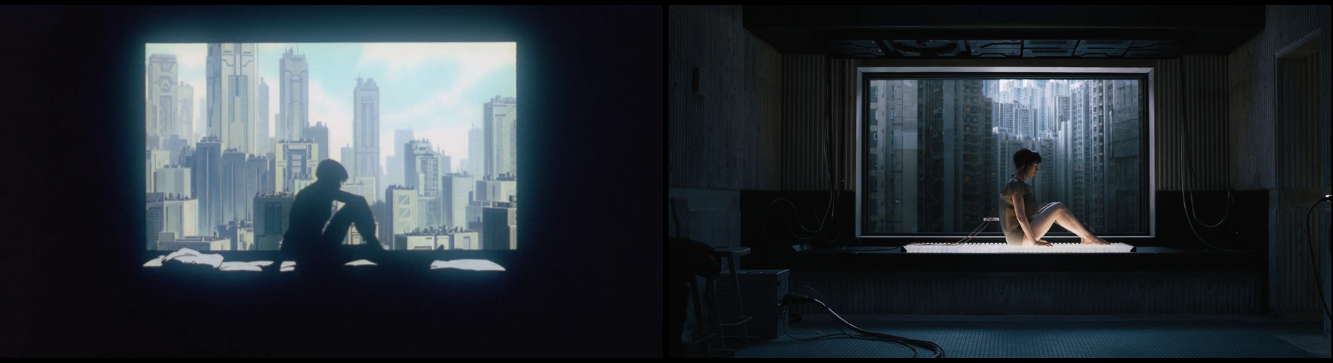
Grace: Okay, I've been giving this same answer for four years now. It’s also the same thing I wrote in my application essay to NTU. My inspiration was Only Yesterday, the Studio Ghibli film directed by Isao Takahata. That was the film that really made me think that yes, I don't just want to do art. I want to do animation and I want to do filmmaking.
The way he wrote his stories was very subtle. But if you give his stories time, you would really feel the emotions at a very, very deep level. In a sense, it might not be a film for everyone. But for those that it touches, it will resonate with you at a very deep level.
So that was what made me solidify my passion. But other than that, I've always liked drawing. Even as a kid, my mum had to collect A4 paper for me every day from her office because I just kept drawing things endlessly. But they weren't even nice drawings — they looked horrendous. But it's because I had all these characters in my head that I would just draw for five seconds, and then the whole set of paper would go to waste. They were draft papers, though, so I wasn't wasting paper. They were already about to be thrown away.
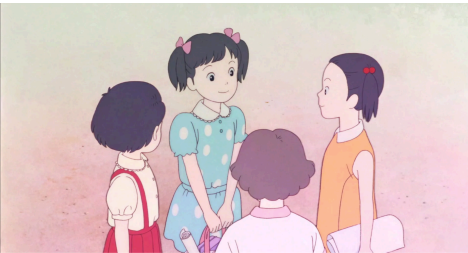
Only Yesterday (1991), courtesy of Studio Ghibli
Lixin: We love an environmentally friendly queen. What about Ben? Was there any incident that made you decide on filmmaking and animation in particular?
Ben: I think my route is a bit more practical. I knew I always wanted to do art-related things. I think childhood drawings are very nice, so I don't think they’re as ugly as Grace makes them out to be. I'm sure hers were great because she's really talented. For me, I wanted to be an artist or be in a creative field. Because I’ve always done art since secondary school and then JC, you know, that kind of MOE Art pipeline thing. So I thought I would go into fine arts. I applied to US [universities] and was very blessed to get in, but I didn't have money, so I couldn't go.
So I ended up in ADM (School of Art, Design and Media at Nanyang Technological University). I was very fortunate to be surrounded by very creative people. And in ADM, there are a few specialisations. And the one which made the most sense to me at that point in time — as someone who does a lot of traditional art, a lot of painting and drawing — was animation. Because I could draw the most there, and be in touch with translating my eye, my mind and my imagination to the visual form. So that's why I chose animation. It's kind of practical, I guess.
Lixin: That's interesting to hear. I don't know much about NTU ADM, because I was from NUS. Is animation considered a popular or mainstream specialisation in the faculty?
Ben: My batch had a pretty big animation cohort — very talented, passionate people. But sometimes the batches differ. I wouldn't say it's the most popular — that would probably go to graphic design or visual communications. But I think it's a bit more popular than the rest.
Lixin: How big is the cohort actually?
Ben: In total, there's about 140 people, I think. And then we just go off into our different specialisations over the years. You kind of know everyone because we gather quite a bit and we see each other around.
Lixin: Very interesting. How did you begin your collaboration?
Grace: We met in the very first year, because we were put into the same class. How ADM works in the first year is that you take [the same classes] before you split into your specialisations, and people in the same class become very close. Because we both chose to specialise in animation, it became a smaller group of friends. And then after that, we felt like we could work together pretty well. Because everyone had rather distinct styles, but we felt that our styles were compatible — they built on each other.
And that's something that is very important in collaborating for filmmaking. We could also bounce ideas off each other. We just had the same direction and inspiration. So that showed us that we could definitely work well together.
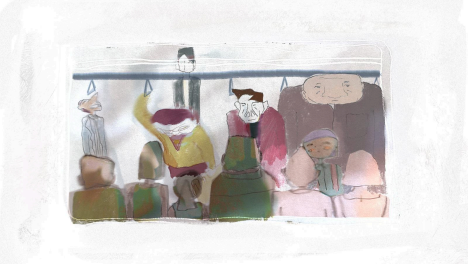
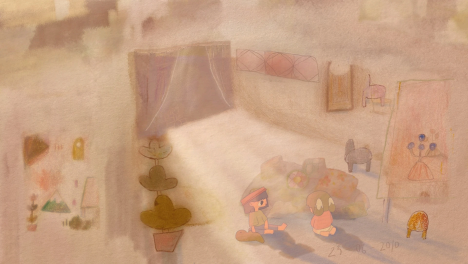
Concept art from Mountain Mountain, courtesy of Ben and Grace
Lixin: What were your inspirations in particular behind Mountain Mountain?
Ben: Grace and I went on exchange at Griffith University in Brisbane. It was pretty fun. Afterwards, we went on a little trip to New Zealand. In Queenstown, there were a bunch of mountains surrounding the place where we lived. I think that was a big source of inspiration, being able to be surrounded by natural landscapes which are so much bigger than ourselves. It was very inspiring and also very humbling. You realise how small you are, how small your problems are. But it also makes you feel bigger than you are. So I guess there's a duality to it, which is interesting. That became a lot of the source material and the emotional material for Mountain Mountain.
For me, I was also quite inspired, emotionally, on a more personal level. I have friends in the creative sphere who are a bit lost or uncertain about where they are headed. I think that's where I am now. So strangely enough, the film actually gives me some sort of solace. It's like talking to myself in some way. There's this sense of uncertainty as young adults. Where are we headed? Are we on the right path? What should we do to get to where we want to go?
The film is about knowing that there is great comfort within yourself, that you are capable of more than you think, that there is great power in intuition, and just trusting yourself and the process. To me, that’s what the film is about, an act of faith and of knowing. I know people have different interpretations.
Grace: Since it was a collaborative film, we discussed a lot together before embarking on the film. And mountains were one of the things that spoke to both of us. What really struck me in New Zealand when we were on the exchange [trip] was looking out the window and seeing a mountain right outside. And that was so striking to me because it's something you will never ever see in Singapore. Even if you go to the furthest end of the island, you can't find that here. I wanted to bring that emotion back in a certain way through this film.
And the mountains also resonated with Ben. We wanted to work on something that we both felt strongly for because the film isn't just for one of us — it's coming from the both of us and I think that's quite important. But what carried me through the film was my religion. Especially in Singapore, a mountain is more commonly used as a symbol of an obstacle or something you have to go past. But for me, when I see a mountain like the one we saw in New Zealand, it's really something so steady, so firm and so big that it gives me a sense of assurance. So that was what carried me through the film, which might be similar to what Ben said about faith.
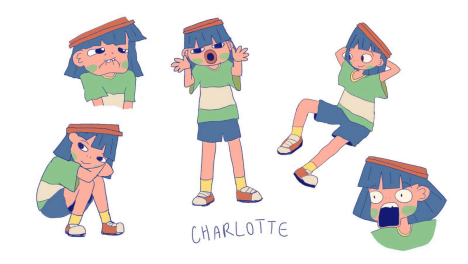
Concept art from Mountain Mountain, courtesy of Ben and Grace
Lixin: That’s beautiful. Goodbye Old Fish, the other short film that you collaborated on, is also quite connected to nature. Do you feel that being located in the metropolitan city of Singapore affects your relationship with nature and how you choose to express it in animation and film?
Ben: For us, nature is very peaceful and calming. A lot of the time, I can just sit in one place, observe things and be present in the moment. There’s something that's quite beautiful about nature, which Singapore doesn't have. I mean, Singapore is a metropolis, so there are a lot of cars, movement, and things happening. But when you go to a park or when you sit by the [seaside], it's very calming and peaceful.
I personally find myself always drawn to these places. Going to East Coast Park just to be present, to be still with myself and with my thoughts. I don't think it was really intentional that there was always a natural element. But, to some degree, maybe that's why we're drawn to natural things, at least as a filmmaker. Because I naturally like these big outdoor spaces and contemplative environments, which I think nature evokes for me.
Lixin: That’s very interesting. If I may add on a bit as well… I went to Switzerland with my friends, and it's like what Grace said. When you're on the train, you see so much of nature, and it's so grand. But, oddly for me, when we went to the midpoint of one of these mountains, it just seemed so unreal to me. I was so used to seeing pictures of these gorgeous Natural Geographic shots by reporters that when I was actually in front of the real thing, I couldn't put it into my mind that what was in front of my eyes was real, instead of just being another photo.
But when I was watching Mountain Mountain… Even though it's animation, which should seem less real than a photo, I somehow felt a deeper connection through the animated style than by actually looking at a physical mountain. Which I thought was amazing, and really speaks to the power of animation.
Grace: Actually, that kind of relates to my answer to your question. Because I would say that nature is a feeling. We don't see a lot of it in Singapore. I mean, we do have a lot of trees because the government desperately tries to plant trees. But we don't have the kind of picturesque nature you would often see in other places. Yet that doesn't mean that we can't find it in our own way, in our own spaces that we have around us. And I think being a Singaporean, maybe it's not so much about always seeking out nature, but maybe just appreciating what's natural. Like I could look at a HDB flat that has been very nicely painted — maybe it's kind of old, kind of vintage. And I have that same nostalgia and that same sense of comfort, that same feeling that I would have if I were staring at an oak tree.
So in a sense, yes, we do have a lot of beautiful things to see in the rest of the world, and sometimes we gain inspiration from those. But also, there's so much in our own city, in our own home, and around us, that gives us that peace that we feel strongly for. Yeah, so I wouldn't say that nature is what ties both films together. It's really just what's authentic and what comes from your heart.
Lixin: As an amateur, I'm very curious about the process of creating the film. Was there a timeline that you were working with?
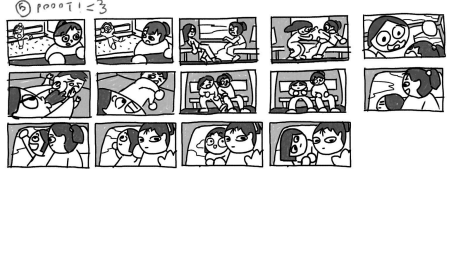
Storyboard from pre-production, courtesy of Ben and Grace
Ben: We did have a rough timeline. We went on a very non-linear approach, going by feeling and faith that it’ll work out if we put our heart and soul into this. It was a very unconventional animation approach. There’s no right path, right? It depends on the kind of story that you're building and the process is shaped by the story. But a lot of our friends had more structured timelines.
A bit of a preface for animation: There's usually a production pipeline. So there's a pre-production where we do storyboarding and concept design. Then we move into production, which includes the things that actually show up on screen like the line work, colouring the backgrounds, etc. Then there’s post-production, which is when we add sound and put all the different layers together, including the color, the lines, and the backgrounds.
Ours was a bit strange — especially the pre-production phase. A lot of people start from scripts, but we went from images and our feelings towards these images, and had this rough idea of, oh, they're just going up this cable car. Then, if we like a certain image, we'll try to include it inside the animatic. Or like the sequences of storyboards… It was very free-flowing and experimental. We would try a lot of different styles and different approaches, and see what fit and what didn't fit the story. So it's really like a bit of everything from everywhere and very, very messy, but I think we managed to pull it off. I don't know how. Maybe Goodbye Old Fish trained us to work in this semi-messy way. It's just a miracle that it happened.
Lixin: Could you share more about the voice acting in Mountain Mountain?
Grace: We got ourselves and our friends and family to do the voice acting. We wanted to hire professional actors at first, but because a lot of the inspiration from the film in the end came from the experiences around us… As much as possible, we involved those people and felt like that would be what made it more authentic. So we threw away the idea that you need a professional voice actor for things to sound genuine. The voice acting part was really fun because it was with people we knew. That was probably my favourite part of the filmmaking process.
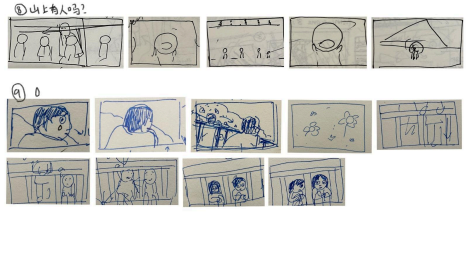
Storyboard from pre-production, courtesy of Ben and Grace
Lixin: How does the division of labour work in an animation film where two people are both animating and illustrating?
Grace: The way we split it is again a bit unconventional. When we were making the film, we split it into the main scenes with Charlotte and Valerie, and the cutaway scenes that have a different, more experimental art style. So Ben and I shared the workload for the main scenes and we also each took on certain cutaway scenes. That means maybe he does one, two, three, and I do four, five, six. So in that sense, it allowed us to firstly have a unified art style for the main scenes, which we worked out together in pre-production. And then for the cutaway scenes, it gave us room to experiment in our own ways and express our own artistic creativity. Of course, at every given point in time, we were checking back with each other and bouncing ideas off of each other. So that's how it was in the end.
Lixin: What are your plans for the future?
Ben: This is still a possibility because it's not firmed out yet, but I believe I will be making another film with a very dear friend of mine. So that might be coming out sometime, I don't know when. For me, I think career art and personal art are quite different. For personal art, I think I'll continue filmmaking.
I think there are very few professional studios that allow filmmakers to do this. Of course, there are NAC grants and things like that. That's also a possibility. But I think that's quite a few years in the future. For now at least, I’ll be doing art within my own means, telling very Singaporean stories and making use of Singaporean locations. I've always wanted to do films that are set in specific neighbourhoods like Serangoon, where I live, or Bukit Panjang or Holland V. They're very interesting locations, which I think can really speak to Singaporeans.
It just feels more sincere. There's more of a story to tell when I can understand where these places come from, the history, and also a deeper sense of shared understanding, having grown up here, and lived and experienced these places for a few decades now. That's what I will continue to do. And also, keep drawing. That’s very important. And also make some music. So those are my plans. Along with finding a job — but that just has to be done.
Grace: I would say I don't have any solid plans. But in this particular season of my life, what I've been going back to is why I started doing art five years ago. It was because I wanted to make art that could help people. I know that art can't save lives like doctors do.
But for me, I wanted to make art that can be like a friend to someone because there are days that I'm sad, I go home, I go into my room… Maybe you don't even want to talk to anybody, but you just watch something. Or see a lot of art that someone else did and feel understood, or seen, or heard. I don't really know what my plans are in a solid way. It could be through film, it could be through painting, it could even be through writing a narrative, which is also a form of art. Basically, the only thing that I know I want to do is I want to make art that comforts people and brings peace to the people around me.
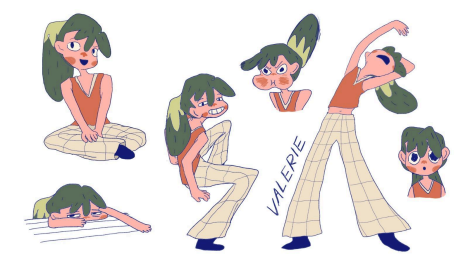
Concept art from Mountain Mountain, courtesy of Ben and Grace
Lixin: Do you have any message you would like to leave to other young creators like yourself?
Ben: It's a bit hard to answer this question with perspective because I'm still very young. I'm only 27 this year, so there's a lot more life to be lived, I think, before I can give an answer that's grounded. But in my experience… Like Grace says, don’t forget why you draw in the first place. I think there is great joy in the process of drawing. You don’t have to assign it value, you know? It has to be good, it has to be this, or it has to be that. I think it can be whatever it has to be for you. I think that is the deep beauty of art and of human connection as a whole — it is diverse and it is wide and it is tall, long, and whatever you want it to be.
So don't forget what you draw and always find joy in the process of it. Just the act of putting pen to paper or paintbrush to whatever. I think that's always the most important thing as a creative. Of course, there are a lot more complexities, but that’s something I often try to ground myself in too. When I get lost in the mud of oh, should I do this, should I do that? Should my portfolio be like this? Yeah, I think that's very important.
Grace: I would say don't forget to live. Because, being an artist, sometimes we get caught up in the craft. In a sense, you are constantly trying to prove yourself, whether you know it or not. Because art is such a personal thing. But if you don't live, you can't make art. So if art is tiring you out, just don't do it. Just go to Japan, take a vacation. Just don't do art. I'm not gonna sketch. I'm not gonna do any art. I'm just gonna take a break. Just live. Because at some point, if you are living your life, your life is gonna flow into your art.
And you can't forget yourself. If you forget yourself, you can't make art. You can, but you won't make art that you're happy with because it has to come from you and your life and who you are.
–
Ben Tan Kai Xiang is an animator and illustrator with a deep love for the tactility and formal beauty of traditional art. He can be found on Instagram @bentankx.
Grace Cheu is a multidisciplinary artist who often tells stories with a gentle, contemplative voice using subtle themes and motives to convey deep human understanding. She can be contacted at gcheuliqing@gmail.com.
---------------------
About the author: Lixin is an incorrigible dreamer who will probably never stop imagining conversations between characters while commuting on the MRT. Outside of a corporate day job, her creative fiction can be found in various literary magazines.
This review is published as part of *SCAPE’s Film Critics Lab: A Writing Mentorship Programme, with support from Singapore Film Society.
Recent Posts