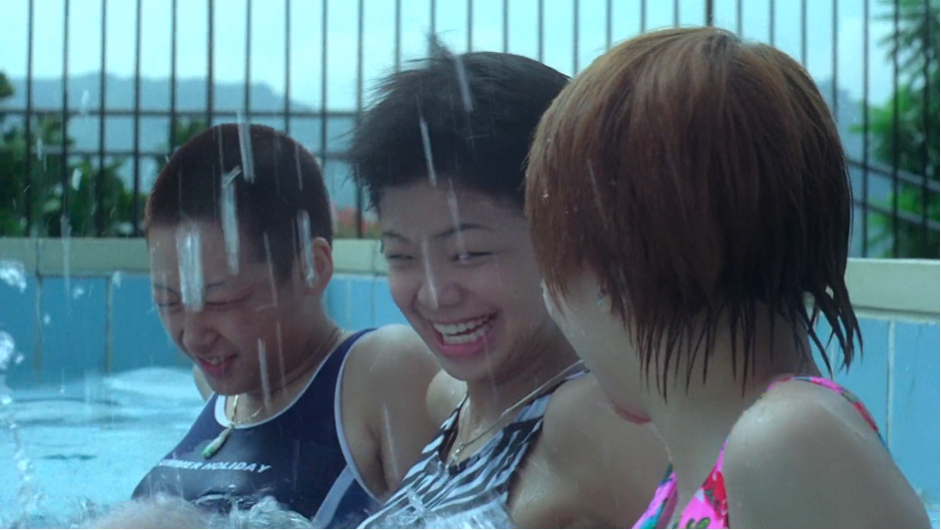
Film still from Spacked Out
Spacked Out
centres on the turbulent lives of youths in Hong Kong, primarily four teenage girls ages 12 to 13-years-old. Set against the backdrop of modern Hong Kong as it approaches the new millennium, the film captures brightly lit malls, neon-coloured street signs and wacky fashionable outfits adorned by the teens.
Interestingly, the colourful mish-mash of clothing and accessories fashioned by the teen girls first struck me with its familiarity as the Y2K trend has been resurfacing in current times. Despite being released over 20 years ago, the film’s visuals, themes and concerns are still relevant. Through its mise-en-scene and thematic concerns, the film itself brings about a similar experience that emphasises the inbetween-ness that girlhood exudes and it is characterised by the nostalgic transience of girlhood.
The film opens with Cookie’s (Debbie Tam Kit Man) monologue as she voices her feelings of isolation and abandonment by her loved ones. With her mother absent and her best friend, Mosquito (Lam Hoi Man), sent off to a reform school, Cookie finds herself lost and left to her own devices. Along with her group of rebellious friends, the film explores their youthful woes as they go about their day-to-day lives. Initially, the plot appears mundane as the camera trails after the girls to school (where they fool around and avoid studying), to retail stores, the KTV room, loitering aimlessly. Soon, however, we come to realise the unique yet universal teenage troubles underlying their otherwise average school lives.
Through the lens of subcultural youth communities in Hong Kong, the film captures the private struggles of the four protagonists' budding years, depicting their awkward transitions from adolescence to teenagehood. The prevalence of Hong Kong’s youth gangs and drug abuse amongst youths have long been recognised and documented, noting the cultural and social significance of these practices over the decades. As Lawrence’s film displays, the girls and their peers often bond over their vices whilst exercising their independence.
The film presents itself like an amateur piece, picturing scenes of inexperienced actors who, on occasion, cast glances at the camera and recite their lines in staged tones. In fact, fragments of Debbie’s personal schooling experiences were included in the film’s narrative. Indeed, these moments of breaking the fourth wall and the infusion of the actresses’ real-life accounts were what gave
Spacked Out
its vivid authenticity and heightened its sense of liminality -- between past and present, reality and fiction.
Uncomfortably realistic in its depiction of ignorant and self-indulgent youths,
Spacked Out
, highlights the cruelty these unassuming youths are capable of. Bean Curd (played by Maggie Poon) appears the most crude amongst the quartet. Her shaven head, brash speech and sharp gaze concretise the tough persona she exhibits. In one shocking scene, Bean Curd taunts a distressed classmate to commit suicide upon noticing her self-harming with a penknife.
At the film’s climax, a series of unfortunate, though foreshadowed, events occur. Upon receiving a call from Banana’s (Au Man Sze) god sister, the girls head to her apartment in search of refuge where they are soon joined by a group of boys. A nightmarish breakdown soon takes place. Intoxicated by alcohol, tobacco and drugs, sexual tension and jealousy surges in the small space. Multiple betrayals occur as the girls flirt with their new male interests, leading to Bean Curd’s attempt at suicide through self-harm (in an ironic twist of events) and the god sister’s overdose on drugs, which ends in a tragic death.
Having lost their sense of reality, the girls turn on one another and themselves. As such, while drugs and alcohol are abused as emotional escapes for the characters, they also result in a trance-like state where morality dissipates.
Later in a haunting scene of moving plastic dolls and threatening close-up shots of surgical equipment, Cookie finally undergoes a traumatic abortion. However, the film ends as inconclusively as the rest of its directionless plot, and we find ourselves once again at an impasse. Despite the chaos that had just ensued, they become estranged events from a bygone time. The girls return to their lives, to the light-hearted pool session and stasis, and all that had happened appears tucked away in memory.
In the plot’s directionless form, a sense of ennui pervades the film and it is this sense of liminality that corresponds with one’s own perception of girlhood. Girlhood is a time of uncertainty and becoming that occurs and remains in the past, lingering only in memory. This is not to say that actions are inconsequential in one’s youth, but rather they are at times wishfully forgotten as one approaches adulthood.
The film’s nostalgia for youth is bittersweet, as the past is marred with countless wrongs. Where the film does superbly well is in its making real and vivid an otherwise fleeting time in our lives. Lawrence emphasises this crucial stage in the characters’ teenage years, and roots its importance through its twisted reality. Far from the innocent girlhood of which one may view through rose-tinted glasses, the film acknowledges the cycle of self-discovery and self-destruction. Cookie, caught in her own uncertain and unstable youth, hovers between wanting change yet being unable to pursue it.
In spite of the evident cruelty and selfish ignorance of the girls,
Spacked Out
distances itself from a moralistic presentation of their behaviours. Instead, Cookie’s narratorial voice provides the main mediation for the ugly events taking place. Cookie frequently reminisces about her close friend who has moved away yet has not contacted her, and she dreams of a simple but unattainable escape from her sordid reality. Her narration informs the audience of her naive yet hopeful outlook for the future — one that is embodied by the mature and elegant girl she befriends at the pool. Through her voice, the film makes prominent her innocence that persists despite the harrowing events that threaten it.
By revealing the ugly realities behind teenage girls’ closed doors, the film peers into their inner psyche. As the contradictory traits of self-importance and self-loathing plague the characters, it appears a necessary, albeit unpleasant, process towards self-understanding. Within this liminal space and time, girlhood undergoes various states of confusion, experimentation and self-realisation. Setting aside pointed blame thus,
Spacked Out
incites empathy as well as the audience’s contemplation of their own uncertain and possibly, hormonal youths.