Film Review #97: ART COLLEGE 1994

Justen Khoo • February 11, 2024


Film Review #97: ART COLLEGE 1994

*This film review may contain plot spoilers, reader discretion is advised.*


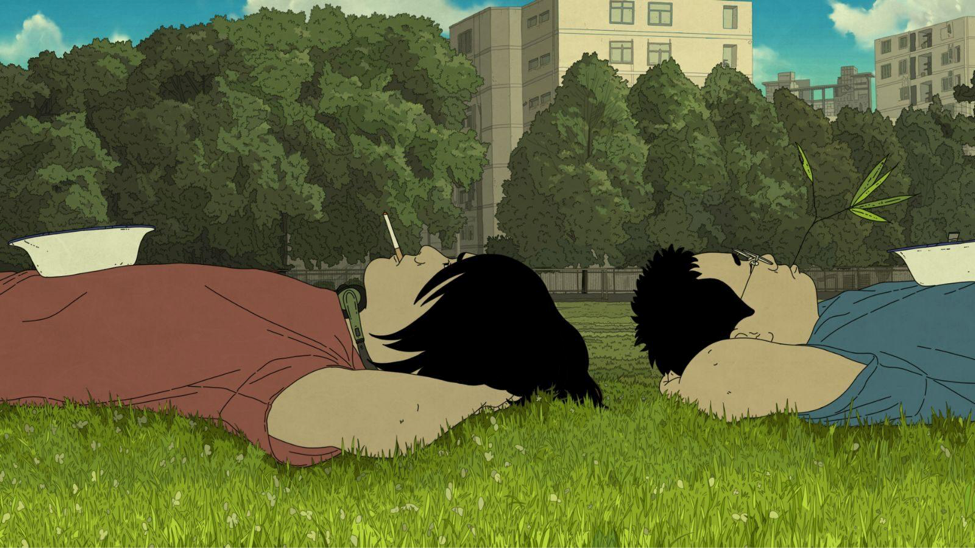
Art College 1994 is enchantingly anachronistic. Despite being animated, it adopts a visual style where the drawings are so clearly referenced from footage of real actors that it borders on rotoscoping. Compare its drawings with ones found in films such as The Case of Hana and Alice, where real life footage is traced and drawn over in order to give the appearance of gesture over the course of multiple drawings rather than the solidity of form demanded by typical animated works.


In Art College 1994, the drawings are also traced over, but are more sparse. Instead, the way the characters move is animated with enough clarity that we can understand that they were drawn with more attention than the typical gestural nature most rotoscoped works assume. Despite technically being donghua (动画, literally meaning animation, but more colloquially used to refer to animated works from China), it stands out in a medium filled with mythology-inspired works with its grounded, low-action setting. There are few better places for a film on the crossroads of both style and country to situate itself than in university, in between adolescence and adulthood.


Film still of Art College 1994


Enter: The Chinese Academy of Arts. Among its students are the long-haired Xiao Jun, his best friend Rabbit, their rival Lin Weiguo, and a dozen other prospective Picassos looking to carve their names onto some canon or another. 


Director Liu Jian’s characters mull about artistic cliches and debates anyone who’s ever seen Rothko discourse on their instagram feed will no doubt be familiar with; representative vs abstract, contemporary vs classic, installation vs sculpture, passion vs money. There is a sense of familiarity as we see these slackers from three decades ago go through the same rhythms of debate and gossip that we find ourselves so used to. We visit another gallery, another show, watch another movie, wondering if this will be the piece that lets us justify to ourselves why we ever decided to identify as something as self-absorbed as an artist.


Still, there is a composed joy to be found. It is in times like this where we begin to notice form, rather than content. A lot of the watchtime is spent by the viewer trying to suss out how sincere any character is at any time. There is a moment in the film where music student Gao Hong beams as she talks about how her stints singing at bars is sure to blossom into a career, but how much does she believe it? In times like these, one recalls Umberto Eco:


“I think of the postmodern attitude as that of a man who loves a very cultivated woman and knows that he cannot say to her "I love you madly", because he knows that she knows (and that she knows he knows) that these words have already been written by Barbara Cartland. Still there is a solution. He can say "As Barbara Cartland would put it, I love you madly". At this point, having avoided false innocence, having said clearly it is no longer possible to talk innocently, he will nevertheless say what he wanted to say to the woman: that he loves her in an age of lost innocence.”


Eco, like us, is aware that in our modern age, there is no narrative we could live that hasn’t already been lived for us by dozens of Kurt Cobains, Salvador Dalis, and Frida Kahhlos on our screens and newspapers. But of course, this doesn’t prevent him from telling his very cultivated lover that he loves her. Rather, he admits that he cannot love her in a way that is novel (perhaps the ultimate defeat in a culture so bereft of new images). Yet, he would like to love her anyway.


It is this space between cringeworthy irony and painful sincerity that the film finds itself. Every character in Art College 1994, like all of us, must eventually admit that there is a part of us that wants to create something good and true, that resonant, total work of art. Yet, even in art school, a space ostensibly dedicated to that very dream, the reality of the waking world weighs heavily on the minds of Xiaojun and his cohorts. And so, instead of making art, they spend most of their time talking about art.

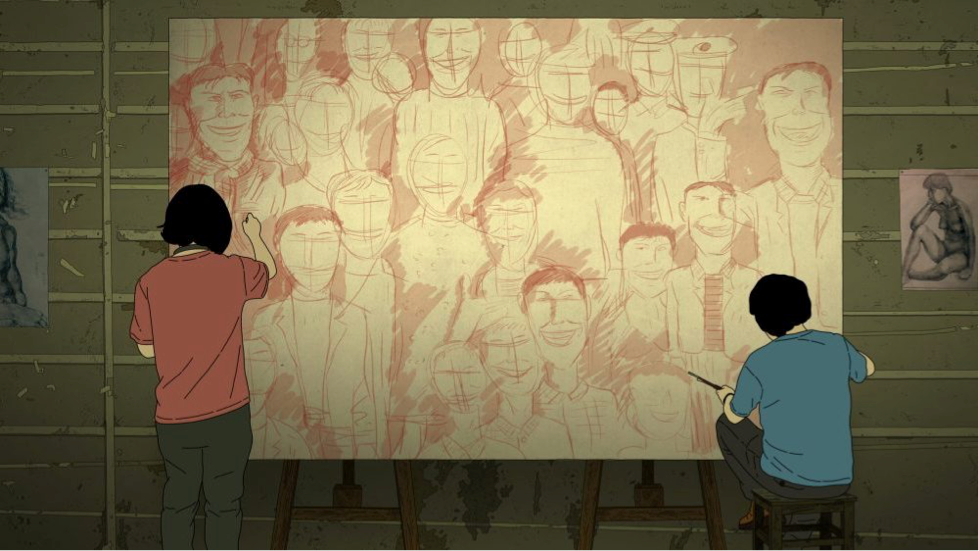
Film still of Art College 1994


It’s a snapshot of an art school in 1994 as much as it is a snapshot of an art school in 2024. More importantly, it is a document to every time you’ve found yourself wondering if you can leave the gallery, and the ultimate tribute to the sleeping losers of the world.


——————————————————————————-


This review is published as part of *SCAPE’s Film Critics Lab: A Writing Mentorship Programme, with support from Singapore Film Society.


About the Author: Justen is an artist, animator, and writer. Their biggest dream is to create something that sucks so bad it pisses everyone off. Follow them at https://www.instagram.com/diejusten .

BLOG

By Jun Sen May 22, 2026
Ikiru – To Live Or Not To Live? A narrative analysis by Jun Sen of Akira Kurosawa’s Ikiru (1952) – what it means to truly live. 
By Jun Sen May 14, 2026
In Conversation with Seth Cheong An interview with Seth Cheong on his unconventional filmmaking journey and process, hailing from a non-film school background. 
By Chinmaya May 7, 2026
Film Review #199 Film Critics Lab Resurrection
By Pan Wenbo April 20, 2026
SCFF 2026 LINKA LINKA Review
By Amadeus Yeo April 17, 2026
Review: Palimpsest: the Story of a Name (dir. Mary Stephen)
By Victoria Khine April 17, 2026
SCFF 2026 Animated Shorts 动画短片集
By Rachel Xia 夏仲静 April 15, 2026
Film Review: Beyond Reconciliation: Living On in Life of Luosang 藏地的生命诗篇:《洛桑的家事》
By Jarrett Yang April 13, 2026
SFS Review - NO OTHER CHOICE (2025)
Poor Taxi 辽河的士
By Jayden Lim Jie-En April 13, 2026
A Review of Poor Taxi 辽河的士 (2025) 
By Elena Goh April 8, 2026
A Review of I Think I’m Going to Die : Stop-Motion Animation and Womanhood
More Posts