

Berlinale Check-In: How a Catfish and a Kid Stand Up to a Dictator

Sasha Han • March 20, 2023

Berlinale Check-In: How a Catfish and a Kid Stand Up to a Dictator

Stephen Lopez’s beefy-human-HITO (2023) makes its spectacular debut in the Generation 14plus shorts section of the 73rd Berlinale to literally leave a gaping wound in dictatorships. As Lopez puts it during the Q&A session, “I wanted to make something really stupid [since] the politics in the Philippines is really bad.” 


In other words, sometimes, the only way to meet stupid is through stupid.

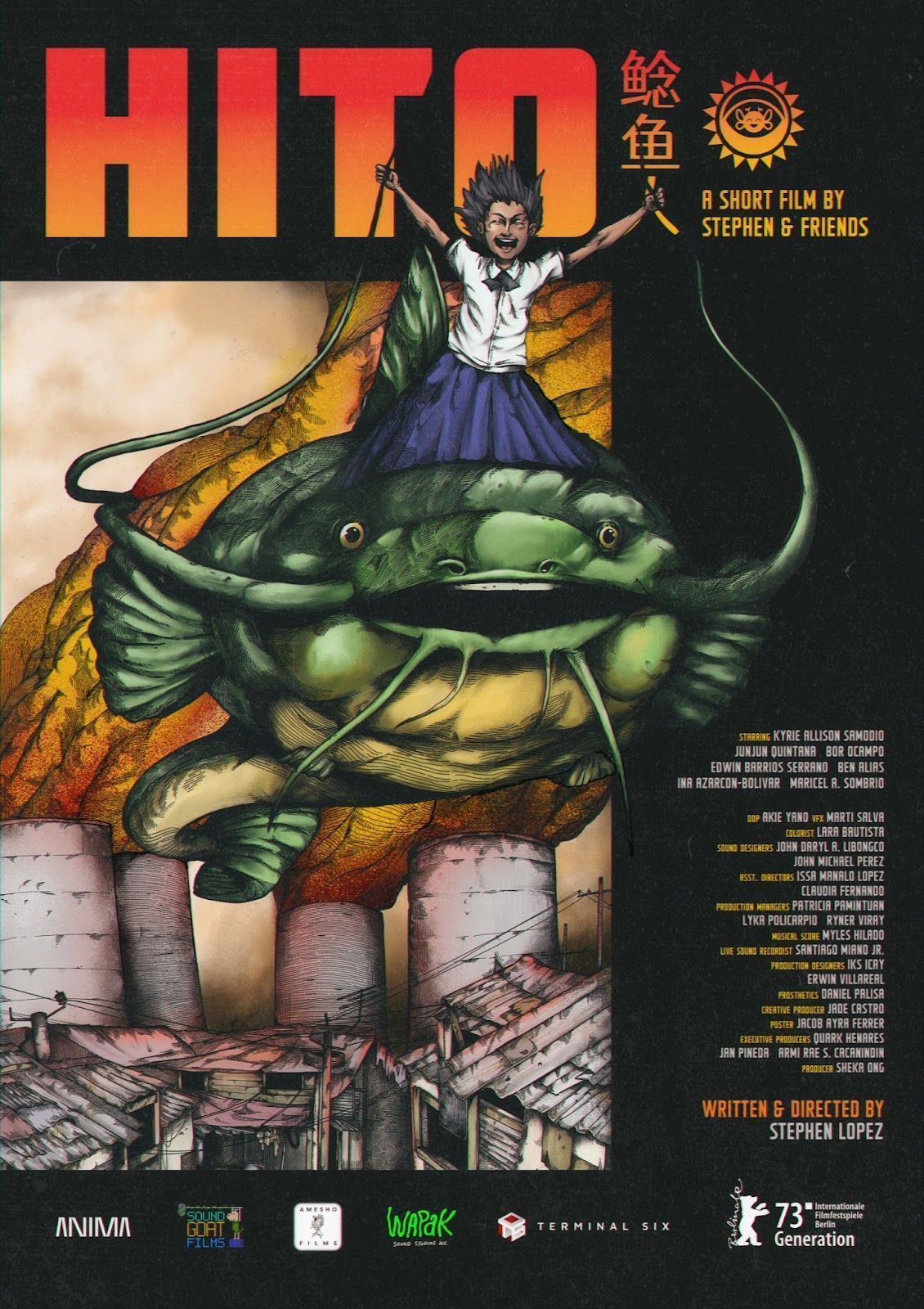
Poster of HITO. Courtesy of Sound Goat.


Set in a Philippines altered by nuclear radiation, the beefy
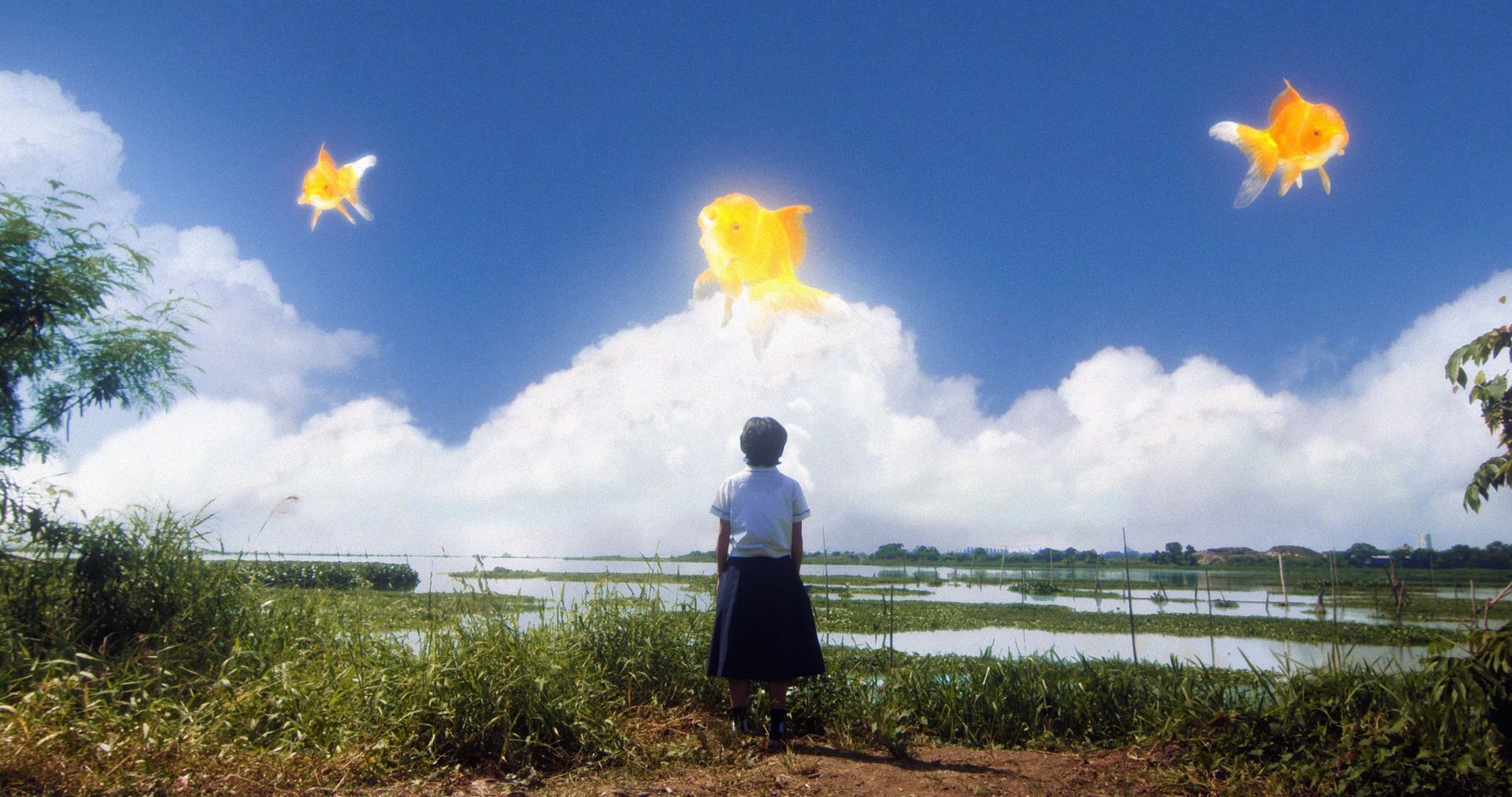
hito mutation is ushered into the saturated landscape by Jani, a young school girl played by theatre actress Kyrie Allison Samodio in her first role onscreen. A series of bizarre occurrences ensue: a holographic Japanese-speaking, fish loving shih-tzu dog makes an appearance to steal fish intended for dinner; Jani is teleported to a secret menagerie to meet its mysterious caretaker who gives her a talking catfish to make up for the lost fish; her parents glitch, twitch and reset, laughing a little too long for comfort as uniform-clad phantom men make brief appearances before disappearing into the abyss. All this, until the speaking catfish introduces itself as Kiefer and reveals the distorted reality Jani lives in, one digitally reconstructed to further enhance a singular narrative imposed by authorities with a brainwashing apparatus.

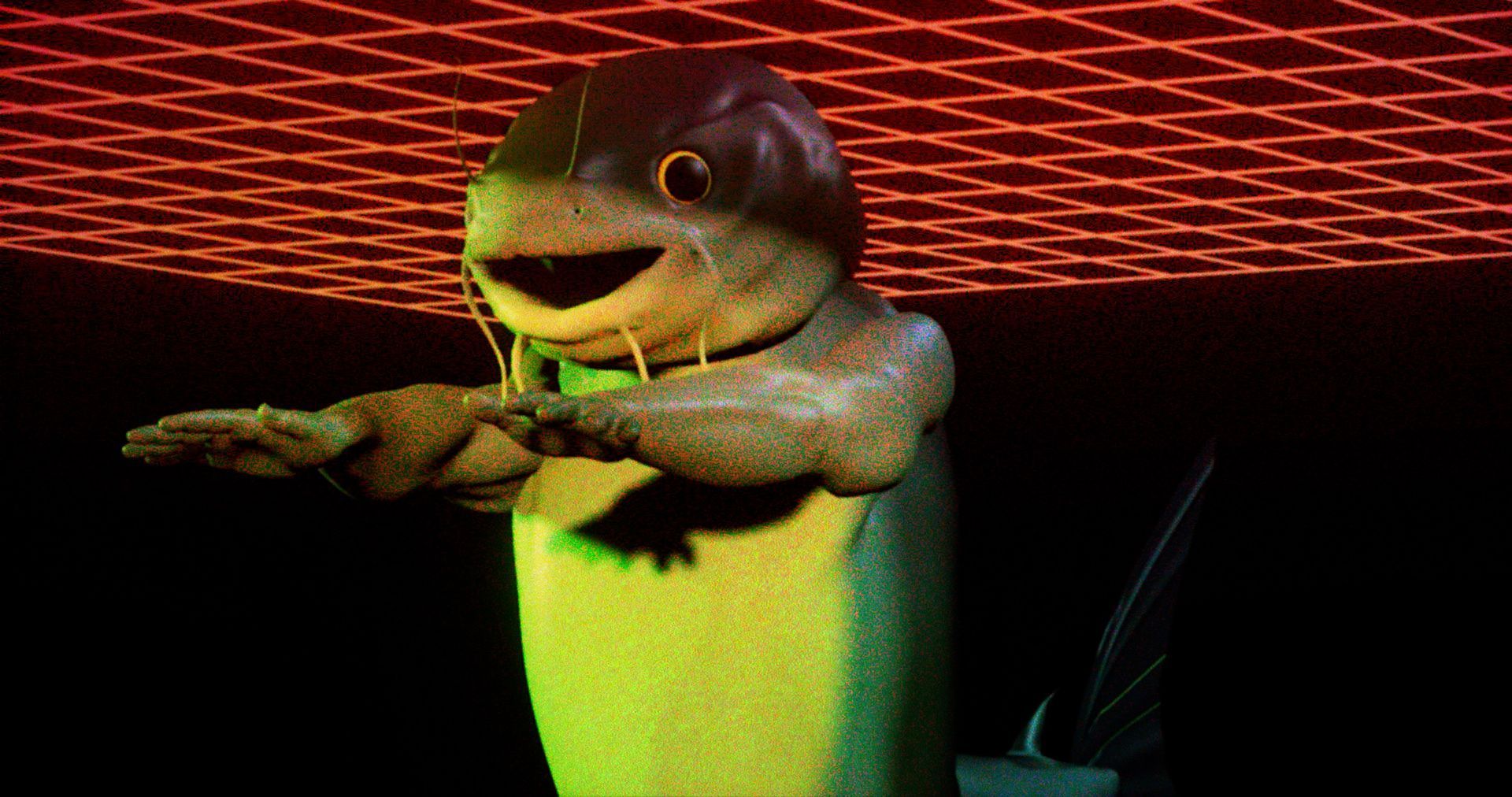
Kiefer in the grid. Courtesy of Stephen Lopez.


Hito
investigates the malleability of history and truth in the Philippines through an unserious consideration for the “logic” of narrative. Working through the kitsch of early web design, its crude cut-copy-and-paste to form fractured tableaus that seem at odds with each other, Lopez reflects the instability of historical fact in his country and its tendency to be edited, rearranged and reinterpreted to suit the purposes of presidential administrations. The film opens with an announcement that mandatory military conscription will soon commence. This, alongside the use of early Internet aesthetic in the film, echoes and marks the return of one President Marcos — son of former dictator President Ferdinand Marcos — and at least two initiatives introduced under the first Marcos’ reign, mandatory military conscription and the activation of nuclear facilities that had languished in the decades since Marcos Sr. was ousted and exiled for, amongst other things, rampant poverty, violent suppression of opponents and his central role in the most illustrious theft of government in history. 


With Ferdinand “Bongbong” Marcos Jr now in power, the past makes an uncanny
return to the present. The bubble-pop colours and cheerful analog props associated with the ‘70s in the film have nothing to do with vapid nostalgia and everything to do with the sticky and awful realisation that the past seems to have been forgotten; nothing has changed. In fact, the processes that support the system seem to have grown more insidious, retreating into the shadows to hide behind the mirage of a screen that seems all too believable. When Jani returns to reality, the officer reveals himself and sincerely conveys that this is a better alternative to the physical violence of the older generation, bemoaning the fact “that their ‘branding’ has become obsolete”, though the violence has merely erased its physical imprint, focusing instead on assaulting the individual’s mind with a spectacle of lies. In one instance, a tray of plain eggs is somehow fashioned into a spread consisting of noodles, meat and a birthday cake — an illusion of excess and prosperity.

Visions of gold. Courtesy of Stephen Lopez.


But fantastic spectacles cannot make up for the real ache in the stomach caused by hunger as the scrumptious spread on the dining table is ultimately revealed to be made of cardboard. The passage of time also sees the inevitable disintegration of machines, indeed systems, falling into disrepair so that the truth surfaces. The matrix of the digital world is portrayed as falling apart, or at least, far more complex than initially designed. The dog owner — a former scientist of the administration who designed a programme to weaponise animals and now seeks to rehabilitate them — is able to hide in its grid and remain undetected. In another instance, Jani fights with a schoolmate over an old Sanyo cassette player. Although she succeeds in retrieving the device, it’s revealed to be broken, the magnetic strip ripped out and unplayable — a sign that the loop might finally be broken. The scene underscores an important consideration: must people keep fighting each other for scraps? 


In a film where humans and catfishes alike are experimented on to be conduits of control for the authorities, Jani and Kiefer’s escape from its web of lies and decimation of its perpetrators stands in bold defiance against its order. Resistance is possible, though Jani’s continuous survival against impossible odds and Kiefer’s evolution into a muscular human-catfish hybrid suggests that radical adaptation must be engaged with. 


In the same Q&A session, Lopez also spoke of the legacy of colonialism in the Philippines and how consecutive occupation by Spanish, American and Japanese forces created a culture of dependence on god-type figures who profess the salvation of a people should they be elected. The sociopolitical attitudes of a people is undeniably characterised by trauma, but also wilful ignorance and short-term memory. It draws attention to Kiefer’s screams for Jani to “WAKE UP!!!” when she is put under to face reality straight on. It is perhaps the most radical thing one can do in the face of unbearable loss. It’s also where friendship and camaraderie can be found.

-------------------------------------------------------------------------------

About the Author: Sasha seeks to reify the fugitive effects of looking through language. She received her BA in 2021 and has worked with HBO Asia, the Singapore International Film Festival and the National Archives of Singapore.

-------------------------------------------------------------------------------

BLOG

By Jing January 31, 2026
Film Review #189: Withered Blossoms
By Chinmaya January 28, 2026
Film Review #188: Bugonia
By Kaela Teh January 28, 2026
The Lost Youth and Digital Loneliness of All About Lily Chou-Chou
By Jing January 17, 2026
Seeing from a Distance: Modern Life through Edward Yang’s Lens in Yi Yi
By Rachel Xia January 17, 2026
Is the Person You Once Loved Still by Your Side? 那个曾经深爱的人还在你身边吗? A reflection on Once We Were Us 观《Once We Were Us》有感
By Han Yiheng January 16, 2026
Commentary: Agnès Varda’s Lessons in Humility
By Jun Sen January 15, 2026
Covert Operations, the Liberation of Truth and the Need to Remember – The Universal Rebellion  Seen in The Secret Agent
By Stephanie December 31, 2025
Feeling Death: Review of Kiarostami’s Taste of Cherry (1997)
By Ivan Chin December 31, 2025
Film Review #182: YI YI
By Jing December 16, 2025
The Music of Memory: Form, Intimacy, and Musicality in Joachim Trier’s Sentimental Value
More Posts